Every website accumulates a library of older content over time. Some of those posts still rank well. Many have silently slipped in Google’s search results. A significant portion are invisible — dragging down your site’s overall authority without ever pulling their weight in traffic or conversions. The solution is not to delete everything and start over. The solution is to systematically refresh old blog posts so that your existing content library becomes a compounding SEO asset rather than a liability.
The process of auditing and refreshing content is one of the highest-ROI activities in all of SEO. When you refresh old blog posts, you are investing in pages that already have backlinks, crawl history, and often some residual ranking signals — giving every improvement you make a head start over a brand-new page competing from zero. This guide covers the entire process from strategic prioritization to technical execution and post-refresh monitoring, giving you a repeatable system to refresh old blog posts at scale in 2026.
This guide connects with our complementary resources on SEO monitoring for large websites, tracking SEO changes in WordPress, and automating technical SEO audits — all of which feed directly into an effective content refresh workflow.
Why You Need to Refresh Old Blog Posts in 2026
The SEO environment in 2026 is more competitive, more algorithmically nuanced, and more influenced by AI systems than at any previous point. Simply publishing new content is not enough when your existing archive is underperforming. Here is why the decision to refresh old blog posts is more important than ever:
Content Decay Is Real and Measurable
Every piece of content experiences what SEO professionals call content decay — the gradual decline in rankings, impressions, and organic traffic that happens as competitors publish fresher, more comprehensive content on the same topics. If you do not actively refresh old blog posts, content decay will erode your traffic over time regardless of how good the original post was. Google explicitly rewards freshness for queries where recency matters, which covers a broader range of topics than most site owners realise.
Google’s Quality Signals Have Evolved
Google’s Helpful Content guidelines, E-E-A-T framework, and AI Overviews all place increasing weight on content that is accurate, current, and demonstrably written by someone with real expertise. Posts from 2020 or 2021 that reference outdated tools, deprecated features, old statistics, or superseded best practices actively signal low quality to Google’s evaluation systems. When you refresh old blog posts with accurate, current information, you directly address these quality penalties.
The AI Content Visibility Problem
AI assistants like ChatGPT, Perplexity, and Google Gemini are increasingly sourcing their answers from content on the web. Outdated content with stale statistics or incorrect information is far less likely to be cited by these systems. When you refresh old blog posts with current facts, updated examples, and structured data enhancements, you increase the probability that AI models will reference your content — bringing in a new stream of AI referral traffic alongside your traditional organic search traffic. Read our guide on Google AI Overviews optimization and Generative Engine Optimization to understand the full AI content visibility picture.
Opportunity Cost of Ignoring Existing Content
Every month you spend publishing new posts without addressing your existing archive is a month of compounding opportunity cost. Pages that already have domain authority, backlinks, and Google trust built up around them are far more responsive to improvements than new pages. For most established websites, the fastest path to significant traffic growth is to refresh old blog posts rather than to produce net-new content.
Step 1 — Build Your Content Audit Inventory
Before you can prioritize which posts to refresh old blog posts, you need a complete, accurate inventory of everything on your site. This inventory is the foundation of the entire process.
How to Extract Your Full Post Inventory
Start by exporting your complete URL list using one of these methods:
- Export your XML sitemap URLs into a spreadsheet — our guide on exporting sitemap URLs to CSV for SEO audits walks through the exact process.
- Crawl your site with Screaming Frog or a similar crawler and export all indexable URLs with their metadata — see our guide on website crawlers from a technical SEO perspective for the right tools.
- Export your Google Search Console Performance data for all pages over the past 12 months — this gives you real traffic and impression data for every URL Google has indexed.
Your inventory spreadsheet should capture, at minimum: the URL, the publication date, the last modified date, the current organic sessions over the last 90 days, the current average position for the primary keyword, total impressions from Google Search Console, and the page’s primary topic or target keyword.
Categorise Every Page Before You Refresh Old Blog Posts
Once you have your inventory, assign each post to one of four categories — these categories determine what action you take on each piece when you refresh old blog posts:
- Keep and Improve — Posts that rank between positions 4 and 30, receive some traffic, and cover topics with ongoing search demand. These are your highest-priority candidates to refresh old blog posts and push into the top three positions.
- Consolidate or Merge — Posts that cover very similar topics, suffer from keyword cannibalization, or are too thin to rank on their own. These should be merged into a single comprehensive post that you then refresh old blog posts properly.
- Redirect and Remove — Posts on obsolete topics, posts with zero traffic for over 12 months and no backlink value, or posts that are factually outdated beyond reasonable refreshing. These should be redirected to the most relevant remaining content.
- Leave As-Is — Posts ranking in positions 1–3 with stable or growing traffic. Do not disturb what is working unless you see clear signs of impending decay.
Step 2 — Prioritise Which Old Blog Posts to Refresh First
You cannot refresh old blog posts everywhere at once. A clear prioritisation framework ensures your effort goes to the posts with the highest potential return first.
The Priority Matrix for Blog Post Refresh
Highest priority — Positions 4–10 with declining traffic. These posts are close to the top but losing ground. A well-executed blog post refresh — adding depth, updating statistics, improving internal links, and enhancing structured data — can push these posts back up with relatively modest effort. This is the most reliable return on investment when you refresh old blog posts.
High priority — Positions 11–30 with historical ranking signals. Posts that used to rank higher but have slipped due to content decay or competitive pressure. These posts have existing authority that makes them very responsive when you refresh old blog posts thoroughly.
Medium priority — Posts with high impressions but low CTR. Identified in Google Search Console, these posts appear in search results frequently but rarely get clicked. The fix is usually to refresh old blog posts by rewriting the title tag and meta description to be more compelling, and ensuring the content better matches what searchers actually want.
Lower priority — Older posts on evergreen topics with steady but unimpressive traffic. These benefit from a blog post refresh but are not urgent since they are not actively declining.
Step 3 — Diagnose Why Each Post Is Underperforming
Before you start making changes, you need to understand the specific reason each post is underperforming. Applying a generic blog post refresh without understanding the root cause wastes time and often makes things worse. There are five primary failure modes to diagnose.
Failure Mode 1 — Content Is Outdated
The most common reason to refresh old blog posts is straightforward staleness. Statistics, tool names, product versions, legal requirements, platform interfaces, and best practices all change. A post about WordPress SEO from 2022 that references outdated plugin settings, deprecated Gutenberg blocks, or old Google Search Console interfaces is a poor user experience and a quality signal problem. Identify every fact, statistic, screenshot, and recommendation that needs updating.
Failure Mode 2 — Content Depth Is Insufficient
If a competitor’s version of the same post covers twice as many subtopics, includes practical examples, and has custom images while your version is a thin 600-word overview, depth is your problem. The solution when you refresh old blog posts is to expand coverage significantly — adding new sections, addressing related questions, incorporating original research or data, and matching or exceeding competitor depth on every dimension the target keyword’s top results cover.
Failure Mode 3 — Search Intent Mismatch
Google’s understanding of what searchers want for a given query evolves over time. A query that used to surface listicle results might now surface tutorial content — and your older listicle post is mismatched with the current intent. Analyze the current top results for your target keyword before you refresh old blog posts. If the format, angle, or depth of current top results looks fundamentally different from your post, you need to restructure the post around the current intent signal, not just update the facts.
Failure Mode 4 — Technical SEO Issues
Some posts underperform purely because of technical problems that have nothing to do with content quality. Before you refresh old blog posts, check each target post for: slow page load speed, missing or incorrect canonical tags, broken internal links, missing structured data, poor Core Web Vitals scores, and indexation issues. Our guide on how to check if your website is SEO optimized covers the full technical checklist. These technical fixes should be addressed alongside content improvements — not after.
Failure Mode 5 — Weak Internal Link Profile
Older posts often lack internal links from newer, more authoritative pages that have been published since the original post went live. When you refresh old blog posts, audit the internal link profile for each target post. How many other pages on your site link to it? Are those linking pages themselves well-indexed and authoritative? Improving internal links flowing into a refreshed post is often the single change that most quickly moves the ranking needle. Our guide on internal linking strategy for SEO covers how to systematically build this network.
Step 4 — Execute the Blog Post Refresh
With diagnosis complete, you are ready to actually refresh old blog posts. A thorough refresh touches every layer of the post — content, structure, metadata, technical elements, and internal links.
4a — Rewrite or Expand the Content Itself
When you refresh old blog posts, always start with the content. Every section should be evaluated against the current SERP to determine whether it needs to be updated, expanded, rewritten, or removed. Specific content tasks in a thorough blog post refresh include:
- Replace every outdated statistic with a current figure, including the source date.
- Update all tool, plugin, and platform references to reflect current versions and interfaces.
- Add new sections covering subtopics that top-ranking competitors cover but your original post missed.
- Remove or compress sections that are no longer relevant or that weaken the post’s topical focus.
- Add a summary or key takeaways section at the top for featured snippet and AI answer optimization.
- Ensure the post answers the primary question in the first 50–60 words of the body content — this is critical for featured snippet eligibility when you refresh old blog posts.
- Add original data, case studies, or first-hand examples where possible to strengthen E-E-A-T signals.
4b — Update Title Tag and Meta Description
Part of a complete blog post refresh is always reviewing the metadata. The title tag should include the current year where appropriate (e.g., “Best SEO Tools in 2026”), match the current search intent for the target keyword, and be compelling enough to improve click-through rate. The meta description should provide a clear, benefit-driven summary that reinforces why a searcher should click your result. These changes alone can significantly lift CTR when you refresh old blog posts, bringing more traffic without any ranking improvement at all.
4c — Refresh the URL and Handle Redirects Carefully
In most cases, you should keep the existing URL when you refresh old blog posts. Changing the URL means setting up a 301 redirect from the old URL to the new one, which introduces redirect overhead and can result in temporary ranking fluctuations. Only change the URL if the old slug is actively misleading or contains a year that makes the post appear outdated (e.g., /best-seo-tools-2019/ should become /best-seo-tools/ with a redirect). For guidance on handling redirects correctly, see our guide on SEO redirects: 11 types and their impact.
4d — Update and Improve Structured Data
Every post you refresh old blog posts is an opportunity to add or improve structured data. At minimum, ensure the Article or BlogPosting schema has an updated dateModified field. Beyond the basics, add FAQPage schema to any Q&A sections, HowTo schema to any step-by-step processes, and ensure your author authority schema is properly implemented. See our guides on adding FAQ schema in WordPress and AI SEO structured data for implementation details. Structured data improvements made when you refresh old blog posts directly improve eligibility for rich results in Google search and increase the likelihood of AI citation.
4e — Fix All Internal and External Links
A blog post refresh must include a full link audit. Check all outbound links in the post — broken external links damage user experience and can be interpreted as a content quality signal. Use the guidance from our fix broken links guide to identify and repair every broken link in the post. Then add new internal links to relevant newer posts on your site that have been published since the original post went live. Finally, add links back from those newer posts to the refreshed post to strengthen its internal link authority.
4f — Optimize Images
Older blog posts commonly have unoptimized images — missing alt text, oversized file sizes, or outdated screenshots. When you refresh old blog posts, audit every image: add descriptive, keyword-relevant alt text, compress images to modern formats like WebP, and replace any outdated screenshots or graphics with current versions. Our guide on image optimization for faster page speed covers all the technical steps. Proper image optimization also reduces load time, which directly improves Core Web Vitals — another ranking factor that benefits from a thorough blog post refresh. For lazy loading implementation, see our guide on lazy loading images in WordPress.
4g — Add or Update the Featured Image
The featured image appears in social shares, Google Discover, and sometimes in Google Image search. An outdated, low-quality, or irrelevant featured image can suppress clicks in these channels. When you refresh old blog posts, create a fresh, high-quality featured image that is optimized in both file size and alt text, represents the updated content accurately, and has a visually compelling design that stands out in search result galleries.
Step 5 — Handle the Refresh Date and Tell Google About It
One of the most important but most overlooked steps when you refresh old blog posts is correctly communicating the update to Google so the freshness signal is properly registered.
Update the dateModified Timestamp in Schema
The dateModified property in your Article or BlogPosting JSON-LD schema is how you formally communicate to Google that the content has been updated. Always update this timestamp whenever you make a meaningful blog post refresh. A timestamp change with no corresponding content change is spam; a timestamp change following a genuine, substantial blog post refresh is a legitimate freshness signal.
Display the Last Updated Date Visibly
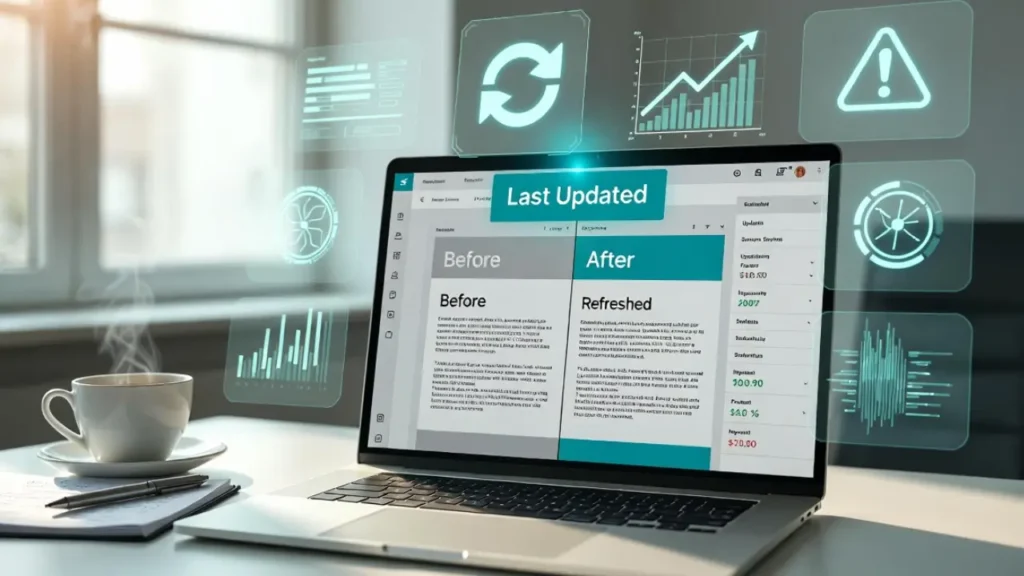
Show the updated date prominently near the byline. This serves both users and Google — users see that the content is current, and Google’s quality signals include visible date signals as part of how it assesses freshness. See our guide on how to display the last updated date on WordPress posts for the technical implementation.
Request Recrawling After Your Blog Post Refresh
After completing a significant blog post refresh, use Google Search Console’s URL Inspection tool to request indexing of the updated URL. This prompts Google to recrawl the page sooner than it would through its regular crawl schedule, accelerating the time to see ranking improvements from your refresh. Our guide on requesting Google to recrawl URLs in WordPress covers the exact process. For newly published content after the refresh, also consider using the IndexNow protocol which pushes instant crawl notifications to multiple search engines simultaneously.
Step 6 — Content Consolidation: When to Merge Instead of Refresh
Not every underperforming post should be refreshed in isolation. When your audit reveals multiple posts covering very similar topics — each with weak traffic, thin content, and no clear ranking differentiation between them — the right approach is to consolidate before you refresh old blog posts.
How to Execute a Content Consolidation
Content consolidation means merging two or more weaker posts into a single, stronger, comprehensive post that you then fully refresh old blog posts as a new canonical resource. The process:
- Identify the URL with the strongest existing signals (most backlinks, best historical rankings, most internal links) — this becomes the canonical destination.
- Migrate all unique, valuable content from the weaker posts into the canonical post, expanding and improving as you merge.
- Fully refresh old blog posts the consolidated canonical post with updated content, metadata, and structured data.
- Set up 301 redirects from all consolidated posts to the canonical post.
- Update all internal links that pointed to the consolidated posts to point directly to the new canonical URL.
This consolidation strategy is particularly effective for reducing keyword cannibalization. Our guide on fixing duplicate content issues in WordPress covers the broader context of why duplicate and near-duplicate content hurts your site’s performance.
Step 7 — Optimize for Featured Snippets and AI Answers When You Refresh Old Blog Posts
The way people consume search results in 2026 is fundamentally different from previous years. Featured snippets, Google AI Overviews, and AI chatbot citations mean that simply ranking on page one is no longer sufficient — you want your refreshed content to be selected as the answer, not just listed as an option.
Structure Content for Featured Snippet Selection
When you refresh old blog posts, restructure each major section to maximize featured snippet eligibility. For question-based headings, provide a concise, direct answer in the first 40–60 words of that section. For process-based content, use numbered lists. For comparison content, use structured tables. These formats are statistically more likely to be selected for featured snippets and are also the content formats most easily parsed by AI assistants when generating answers. Read our dedicated guide on how to win featured snippets using technical SEO for the complete playbook.
Add or Expand the FAQ Section
An FAQ section added or expanded during a blog post refresh serves multiple purposes: it directly targets voice search and conversational AI queries, it provides structured data opportunities via FAQPage schema, and it captures long-tail keyword variations that users actually type or speak. Include at least five to eight questions per refreshed post, written in the natural language of the target audience. See our guide on adding FAQ schema in WordPress for implementation details.
Step 8 — Strengthen Topical Authority Through Your Refresh Workflow
Individual blog post refreshes are most powerful when they are part of a coordinated topical authority strategy. As you refresh old blog posts, think of each refresh not as an isolated improvement but as a node strengthening in a broader topic cluster network.
Align Each Refresh With Your Topic Cluster Architecture
Each time you refresh old blog posts, verify that the post is properly positioned within your topic cluster structure. Does it link to your main pillar page for the topic? Does the pillar page link back to it? Are there adjacent subtopic posts that should link to this refreshed post? Our guides on SEO topic clusters in WordPress and semantic SEO importance provide the strategic framework for this alignment. A blog post refresh that also strengthens the surrounding topic cluster network consistently outperforms a blog post refresh that improves only the individual post in isolation.
Use AI-Powered Internal Linking During Refresh
Modern tools can identify internal linking opportunities automatically as you refresh old blog posts. Our guide on AI-powered internal linking strategies covers how to use these tools to ensure every refreshed post is fully connected to the most relevant related content across your site. Well-structured internal linking during a blog post refresh amplifies the authority of the refreshed page through link equity flow and helps Google understand the semantic relationships between your content.
Step 9 — Monitor Performance After You Refresh Old Blog Posts
Completing a blog post refresh is not the end of the process — it is the beginning of a monitoring phase that tells you whether the refresh worked and what further adjustments may be needed.
What to Track After Each Blog Post Refresh
- Organic traffic changes: Compare traffic in the 4–6 weeks following the blog post refresh to the 4–6 weeks prior. This is your primary success metric.
- Average position: Track the average Google Search Console position for the primary keyword and top secondary keywords weekly for at least 8 weeks after the blog post refresh.
- Impressions: Rising impressions before rising clicks is a common pattern after a blog post refresh — it signals that Google is re-evaluating the post’s relevance for a broader set of queries.
- Click-through rate: If impressions increase but CTR does not, your title and meta description need further refinement even if rankings are improving.
- Core Web Vitals: Check that any technical changes made during the blog post refresh have not introduced performance regressions. See our Core Web Vitals and page experience guide for what to monitor.
Build this monitoring into a structured SEO report. Our guide on how to create an SEO report for your WordPress site covers the reporting framework that keeps refresh performance data organized and actionable.
When to Re-Refresh a Post
If a blog post refresh shows no measurable improvement in rankings or traffic after 8–10 weeks, run a deeper diagnosis before concluding the effort was wasted. Common reasons a blog post refresh fails to lift performance include: the page has canonicalization or indexation issues, the topic has fundamentally changed search intent since the original post, the domain lacks sufficient authority to compete for the target keyword regardless of content quality, or the refresh was not comprehensive enough. Revisit the diagnosis framework in Step 3 and identify which factor applies.
Step 10 — Build a Repeatable Blog Post Refresh Calendar
The most effective content teams do not treat the decision to refresh old blog posts as a one-time project. They build it into their ongoing editorial workflow as a regular, scheduled activity that runs in parallel with new content production.
Building Your Refresh Schedule
A practical ongoing blog post refresh cadence for most sites looks like this:
- Monthly: Run a Google Search Console performance review. Flag any post that has dropped more than 3 positions or lost more than 20% of its organic traffic month-over-month. Add flagged posts to the refresh queue.
- Quarterly: Conduct a full content audit of your top 50 posts by organic traffic. Reassess category assignments (Keep and Improve, Consolidate, Redirect/Remove, Leave As-Is) and update your refresh priority matrix.
- Annually: Do a full inventory audit — all pages, not just your top performers. Identify long-tail posts that have been completely forgotten but might still have refresh potential, and systematically address any orphan pages using the principles from our guide on identifying orphan pages and improving internal linking.
Scaling this process as your site grows requires tracking changes carefully. See our guide on how to track SEO changes in WordPress for the tools and methods to maintain clear before-and-after records of every blog post refresh you execute.
Quick Reference: Blog Post Refresh Checklist for 2026
Use this checklist every time you refresh old blog posts to ensure a thorough, systematic execution:
Content Checklist
- All statistics and data points updated with current figures and source dates.
- All tool, plugin, and platform references updated to current versions.
- New sections added to cover topics competitors cover that the original post missed.
- Thin or irrelevant sections removed or compressed.
- Direct answer to the primary question included in the first 50–60 words of the post body.
- FAQ section added or expanded with at least five questions in natural language.
- Original data, examples, or first-hand experience added to strengthen E-E-A-T.
Technical SEO Checklist
- Title tag updated with current year and improved CTR language where applicable.
- Meta description rewritten to be compelling and benefit-focused.
- dateModified timestamp updated in Article schema JSON-LD.
- FAQPage and HowTo schema added where applicable.
- All internal links audited — broken links fixed, new relevant links added.
- Internal links from other posts added pointing to the refreshed post.
- All outbound links checked for 404 errors and updated.
- All images have descriptive alt text, are compressed to WebP, and sized appropriately.
- Core Web Vitals checked using Google PageSpeed Insights after the refresh.
- Last updated date displayed visibly on the post.
Post-Refresh Actions Checklist
- URL inspected and reindexing requested via Google Search Console.
- IndexNow notification sent if the protocol is implemented on the site.
- Post added to monitoring spreadsheet with pre-refresh baseline data recorded.
- Performance review scheduled for 4 weeks and 8 weeks post-refresh.
Final Thoughts: Make Refreshing Old Blog Posts a Core SEO Strategy
The practice of systematically refreshing old blog posts is one of the most underutilised levers in SEO. Most teams focus almost entirely on new content production, leaving a growing archive of decaying posts that progressively dilute site authority. The teams that build refresh old blog posts into their core workflow — treating it as seriously as new content production — consistently outperform peers who do not.
In 2026, the stakes are higher than ever. Google’s quality signals are more sophisticated. AI systems are selecting sources more selectively. Competitors are publishing more aggressively. In this environment, every post in your archive that is outdated, thin, or technically flawed is a liability. Every post you successfully refresh old blog posts is a compounding asset — improving in authority and traffic over time rather than decaying.
Start with your highest-priority posts using the framework in this guide. Build the refresh habit into your monthly editorial calendar. Measure results diligently. The compounding effect of a consistent blog post refresh program will deliver more long-term organic growth than almost any other single SEO investment you can make.
If you need expert support to audit your existing content library, prioritize which posts to refresh old blog posts, or build a scalable refresh workflow for your team, our Cope Business team is ready to help. Visit our Services Page to see how we support content and technical SEO programs, or contact us directly to discuss your site’s specific situation.
Frequently Asked Questions About Refreshing Old Blog Posts
The frequency at which you should refresh old blog posts depends on your niche and content volume, but a practical baseline is to review your top 50 posts by organic traffic quarterly and refresh the highest-priority candidates at least once per year. Posts in fast-moving topics — technology, SEO, finance, health — may need a blog post refresh every six months to stay current.
A blog post refresh significantly improves the probability of ranking improvement, but it is not guaranteed. Posts suffering from authority deficits — where the target keyword is simply too competitive for the domain’s current authority level — will not recover through content refresh alone. However, for posts in positions 4–30 with existing ranking signals, a thorough refresh delivers measurable improvement in the majority of cases.
You should update the dateModified in your schema markup and display the last updated date visibly on the post. Whether to change the publication date in your CMS depends on your CMS and plugin setup — some SEO professionals prefer to keep the original publication date visible alongside the updated date to signal longevity and editorial continuity.
A blog post refresh preserves the post’s URL, core structure, and foundational content while updating outdated information, adding new sections, fixing technical issues, and improving metadata. A rewrite replaces most or all of the content while keeping the URL. For SEO purposes, a thorough blog post refresh is usually preferable to a complete rewrite because it preserves the historical signals associated with the URL, including any backlinks and crawl history Google has accumulated.
Yes — and this is increasingly important. When you refresh old blog posts with accurate current information, structured data enhancements, and clear authoritative sourcing, you improve the probability that AI assistants will cite your content in generated answers. Structuring content with direct answers, FAQ sections, and proper schema markup all directly support AI citation eligibility alongside traditional search rankings. See our guides on Google AI Overviews and Generative Engine Optimization for the full AI visibility strategy.