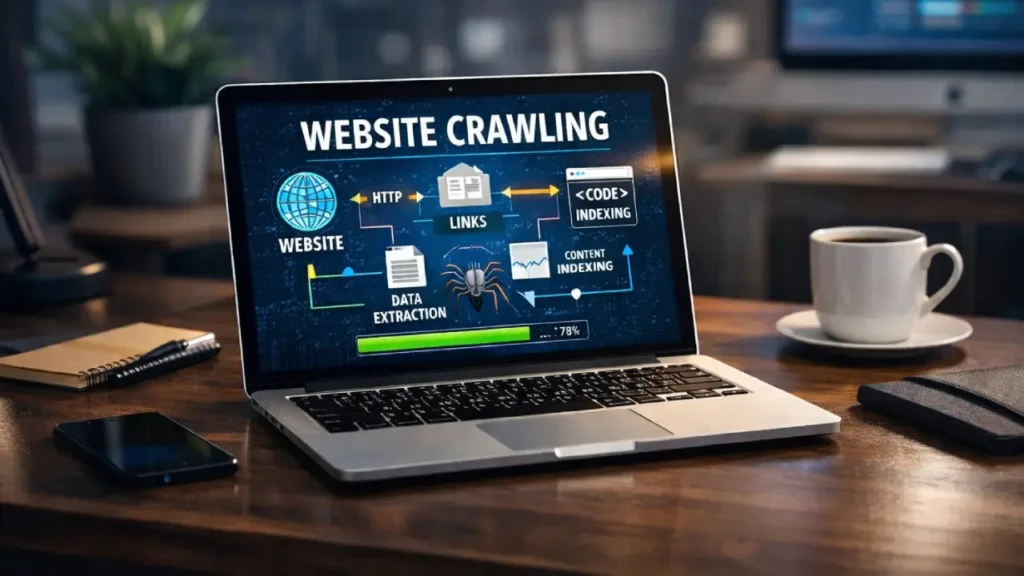
Website Crawlers are the foundation of search engine visibility. Without them, your website cannot be discovered, indexed, or ranked in search engines. From a technical SEO perspective, understanding how crawlers operate is essential if you want higher rankings, better indexing efficiency, and improved organic performance.
Search engines like Google rely on automated bots—commonly called spiders or crawlers—to scan websites across the internet. These bots follow links, analyze content, interpret code, and store data in massive indexes. Every ranking opportunity begins with successful crawling.
In this guide, we will break down how crawlers work, how they interact with your technical SEO setup, and what you must optimize to ensure maximum crawl efficiency.
What Are Website Crawlers?
Website crawlers are automated programs developed by search engines to systematically browse the web. Their job is simple in theory:
- Discover pages
- Analyze content
- Follow internal and external links
- Store information in a search index
However, in practice, the crawling process is deeply technical and influenced by your website’s architecture, internal linking, server performance, structured data, and more.
If your technical foundation is weak, crawlers may miss important pages or waste crawl budget on irrelevant URLs.
How Website Crawlers Work in Technical SEO
1. URL Discovery
Crawlers discover URLs through:
- XML sitemaps
- Internal links
- Backlinks from other websites
- Previously indexed pages
If your site has strong internal linking and a clean structure, crawlers can easily find new and updated content.
For example, proper internal structure like the one discussed in our guide on
Semantic SEO & Its Importance in Modern Technical SEO
helps search engines understand contextual relationships between pages.
2. Crawling the Page
Once a URL is discovered, the crawler requests the page from your server. At this stage, technical factors become critical:
- Server response time
- HTTP status codes
- Redirect chains
- Canonical tags
- Robots.txt rules
If your server is slow or returns errors, crawl frequency may decrease.
3. Rendering
Modern crawlers render JavaScript to understand dynamic content. If your site relies heavily on JS frameworks and isn’t optimized properly, search engines may struggle to interpret content.
Technical SEO strategies such as structured data implementation—explained in
JSON-LD SEO Automation for Dynamic Websites
can significantly improve content interpretation.
4. Indexing
After crawling and rendering, search engines decide whether to index the page.
Indexing decisions depend on:
- Content quality
- Duplicate content issues
- Thin pages
- Canonical implementation
- Crawl signals
Even if a page is crawled, it may not be indexed if technical or quality issues exist.
Crawl Budget: Why It Matters
Crawl budget refers to the number of pages a search engine bot crawls on your site within a specific timeframe.
Large websites especially must optimize crawl budget because:
- Low-value pages waste resources
- Parameter URLs create duplication
- Broken links reduce efficiency
You can improve crawl budget by:
- Fixing redirect chains
- Eliminating orphan pages
- Blocking unnecessary parameters
- Optimizing internal linking
Technical SEO Factors That Impact Crawling
1. Website Architecture
A clear site hierarchy helps crawlers move efficiently. Ideally:
- Homepage → Category → Subcategory → Content
- No page should be more than 3 clicks deep
- Important pages should receive more internal links
2. Internal Linking
Internal links guide crawlers. Without them, pages may become orphaned and never discovered.
Strong internal linking:
- Improves crawl paths
- Distributes authority
- Clarifies content relationships
- Enhances indexing speed
For advanced strategies, you can also explore
AI SEO Optimization: Boost Your Website’s Search Visibility
to understand how AI-driven optimization enhances crawl interpretation.
3. XML Sitemap Optimization
An optimized XML sitemap:
- Lists important URLs
- Signals updated content
- Avoids including noindex pages
- Prevents duplicate entries
4. Robots.txt & Meta Robots
Your robots.txt file controls crawler access. Misconfiguration can accidentally block entire directories, CSS or JS files, or important landing pages.
Meta robots tags like noindex and nofollow must be used carefully.
5. Page Speed & Server Performance
Slow websites reduce crawl frequency. Search engines allocate crawl resources based on server responsiveness.
- Enable caching
- Compress images
- Use a CDN
- Optimize hosting infrastructure
6. Canonicalization
Duplicate URLs confuse crawlers. Proper canonical tags consolidate ranking signals and prevent indexing conflicts.
7. Structured Data
Structured data helps crawlers understand context rather than just text. It enhances rich results, knowledge panels, semantic clarity, and content classification.
Common Crawling Issues
- 404 errors
- Soft 404 pages
- Infinite redirect loops
- Broken internal links
- Thin auto-generated pages
- Faceted navigation duplication
Regular technical audits help detect and resolve these issues before they impact rankings.
How to Monitor Crawling
You should continuously monitor crawl performance using:
- Google Search Console
- Log file analysis
- Site audit tools
- Index coverage reports
Log file analysis, in particular, reveals exactly how bots interact with your site.
Final Thoughts
Website Crawlers are the gateway to search visibility. If crawlers cannot efficiently access, understand, and index your content, rankings will suffer regardless of how good your content is.
From architecture and internal linking to structured data and performance optimization, every technical decision impacts how search engines interpret your site.
Mastering crawler behavior from a technical SEO perspective ensures faster indexing, better ranking stability, improved crawl efficiency, and long-term organic growth.
Need Professional Help?
If you want expert support: Contact Cope Business.