In 2026, the question on every business owner’s mind is simple: Is WordPress still worth it? With the explosion of AI tools, headless architectures, and advanced frameworks, many wonder if the world’s most popular CMS has finally lost its edge. The answer is a resounding yes — but only if you choose the right architecture. This in-depth guide compares traditional WordPress, headless WordPress, and hybrid WordPress to help you decide exactly which path makes sense for your project in 2026.
Whether you run an e-commerce store, a content-heavy blog, or an enterprise website, understanding the strengths and limitations of each approach will save you time, money, and frustration. Let’s break down why WordPress remains one of the smartest choices in 2026 and how the three main architectures stack up.
Why People Still Ask “Is WordPress Still Worth It in 2026?”
WordPress powers more than 43% of the entire internet and continues to grow. Yet the rise of Next.js, Astro, and AI-driven tools has led many to question its relevance. The truth is that WordPress in 2026 is more powerful than ever — but success depends on picking the right model: traditional, headless, or hybrid.
Traditional WordPress gives you speed-to-launch and an unmatched plugin ecosystem. Headless WordPress delivers blazing performance and developer freedom. Hybrid WordPress combines the best of both worlds. Each has its place, and choosing correctly can mean the difference between a site that loads in 300ms and one that struggles at 3 seconds.
In this guide, we’ll compare all three architectures side-by-side so you can make an informed decision for your next WordPress project.
Traditional WordPress in 2026: Still the King for Most Users
Traditional WordPress — the classic setup where themes and the block editor handle both backend and frontend — remains the go-to choice for millions of users. It is fast to set up, beginner-friendly, and backed by the largest plugin ecosystem on the planet.
In 2026, traditional WordPress benefits from Full Site Editing maturity, improved performance tools, and native AI integrations. For small to medium businesses, brochures, blogs, and simple e-commerce stores, traditional WordPress is still the most practical option.
Advantages of traditional WordPress:
- Instant visual editing with the Block Editor
- Thousands of ready-made themes and plugins
- Lower development cost and faster launch times
- Excellent built-in SEO tools like Yoast and Rank Math
Disadvantages of traditional WordPress:
- Can become slower with too many plugins
- Less flexibility for highly custom frontends
- Larger attack surface if not properly secured
If your site doesn’t need extreme performance or custom React components, traditional WordPress is absolutely still worth it in 2026.
Headless WordPress in 2026: Maximum Performance and Flexibility
Headless WordPress decouples the backend (content management) from the frontend (what visitors see). WordPress acts purely as a content API, while the frontend is built with modern JavaScript frameworks like Next.js or Astro.
This architecture has exploded in popularity because it delivers lightning-fast load times, perfect Core Web Vitals, and true omnichannel delivery.
Advantages of headless WordPress:
- Sub-second page loads and superior SEO performance
- Complete design freedom using any frontend framework
- Better security (admin area can be completely hidden)
- Easier scaling for high-traffic sites
Disadvantages of headless WordPress:
- Steeper learning curve for non-developers
- Loss of many traditional theme and plugin features
- Higher initial development cost
Headless WordPress is ideal for SaaS products, large news portals, and any project where speed and custom interactivity are non-negotiable.
Hybrid WordPress: The Smart Middle Ground in 2026
Hybrid WordPress combines the best of both worlds. Some pages render traditionally for fast editorial workflows, while others use headless delivery for performance-critical sections. This is quickly becoming the preferred architecture for growing businesses in 2026.
With hybrid WordPress, content teams keep the familiar dashboard while developers gain modern frontend power exactly where it matters most.
Key benefits of hybrid WordPress:
- Best balance of speed, usability, and cost
- Incremental migration possible without downtime
- Full use of WordPress plugins and Block Editor
- Excellent performance where it counts
Many agencies now recommend hybrid WordPress as the default starting point for most new projects.
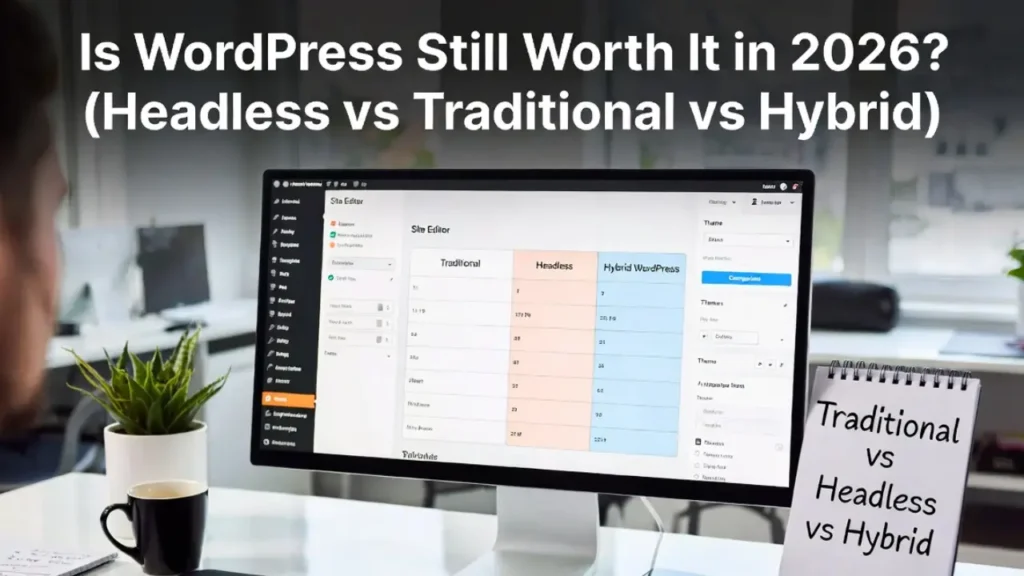
Head-to-Head Comparison: Traditional vs Headless vs Hybrid WordPress
| Feature | Traditional WordPress | Headless WordPress | Hybrid WordPress |
|---|---|---|---|
| Ease of Use | Excellent | Moderate | Very Good |
| Performance | Good | Excellent | Excellent |
| Development Speed | Very Fast | Slower | Fast |
| Custom Frontend Flexibility | Limited | Maximum | High |
| Plugin & Theme Ecosystem | Full | Limited | Almost Full |
| SEO & Core Web Vitals | Good | Outstanding | Outstanding |
| Cost for Small Sites | Lowest | Higher | Moderate |
| Best For | Blogs, small sites | High-traffic, apps | Growing businesses |
In 2026, the clear winner for most users is hybrid WordPress because it avoids the extremes while delivering modern results.
When Is WordPress Still the Best Choice in 2026?
WordPress remains the smartest platform when you need:
- Fast time-to-market
- Strong content management capabilities
- Access to thousands of plugins
- Excellent SEO tools out of the box
- Future-proof scalability
If your project involves heavy custom coding from day one or requires ultra-minimalist performance, a pure framework might be better. For 90% of real-world websites, however, WordPress — especially in hybrid mode — is still the best choice.
Real-World Performance Results in 2026
Businesses that migrated to hybrid WordPress in 2026 report:
- 40-60% faster page loads
- 25-35% better conversion rates
- Dramatically lower bounce rates
- Easier team collaboration
Traditional WordPress sites properly optimized still outperform many custom-built sites in both speed and maintainability.
For the latest optimization techniques, see our guide on WordPress 7.0 Release Features and Upgrade Guide.
Best Practices for Choosing the Right WordPress Architecture
- Start with your team’s skills and budget.
- Prioritize performance but never sacrifice editorial experience.
- Consider future growth — hybrid WordPress gives you the most flexibility.
- Test thoroughly with real traffic before full launch.
- Combine WordPress with modern tools like the Abilities API for AI features.
Ready to Decide on Your WordPress Future?
WordPress in 2026 is more relevant and powerful than ever. Whether you choose traditional, headless, or hybrid, the platform continues to offer unmatched flexibility, community support, and cost-effectiveness.
If you’re unsure which architecture is right for your project or need expert help implementing the best solution, our team at Cope Business specializes in modern WordPress architectures. Explore our full range of services on the services page or get in touch today via our contact page for a free consultation on the best WordPress strategy for your business in 2026.
Thank you for reading this comprehensive comparison. The future of WordPress is bright — make sure you choose the right path for your success.
Frequently Asked Questions
Yes — especially when using the right architecture for your needs.
Only if performance is your top priority and you have development resources.
Not with modern tools and the right guidance.
Yes — incremental migration is one of the biggest advantages.
Absolutely. Native integrations make WordPress one of the best platforms for agentic and AI-powered sites.