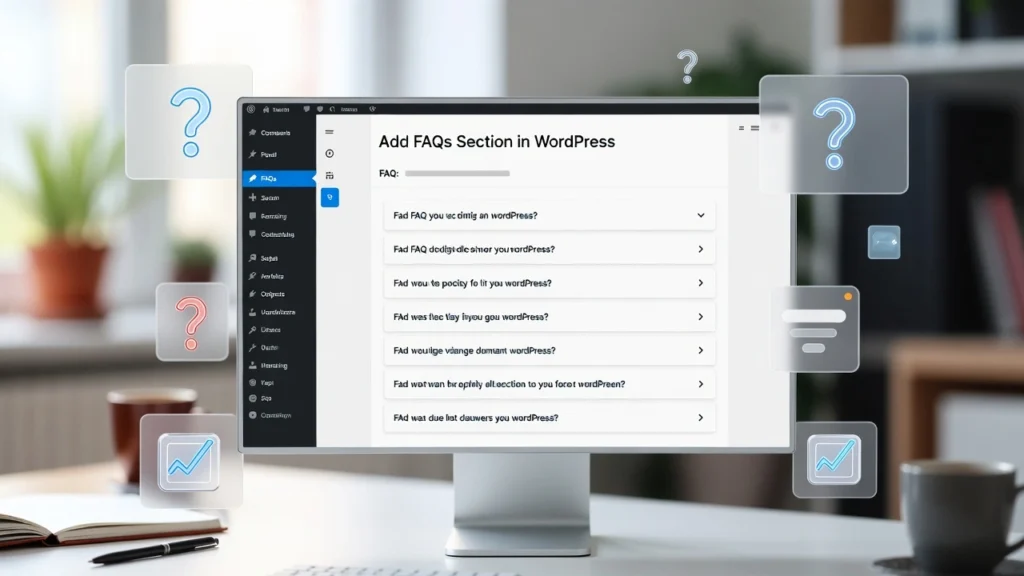
A well-structured FAQ section helps visitors quickly find answers, reduces support tickets, improves user experience, and sends strong SEO signals to Google. FAQs with proper schema markup often appear as rich results (accordion-style) in search, driving more clicks and traffic. At Cope Business, we regularly implement FAQ sections for clients during our technical SEO audit services to enhance on-page engagement and search visibility.
On this page
ToggleThis guide covers two easy and effective ways to add a professional FAQ section in WordPress — using the built-in block editor (no extra plugins) and a dedicated FAQ plugin for advanced features.
Why Add an FAQ Section to Your WordPress Site?
- Improves User Experience — Instant answers reduce frustration
- Reduces Support Load — Fewer emails/tickets for common questions
- SEO Boost — FAQ schema can appear as rich snippets in Google
- Increases Dwell Time — Users stay longer reading answers
- Builds Trust — Shows transparency and expertise
FAQs work great on service pages, product pages, pricing pages, or as a dedicated /faq page.
Method 1: Using Built-in WordPress Blocks (No Plugin Needed)
WordPress 6.0+ includes the perfect block combination for clean, accessible FAQs.
Step-by-Step Setup
- Edit any post or page (or create a new one called “FAQ”).
- Click the + block inserter and add a Group block (or Columns for side-by-side layout).
- Inside the group, add Heading blocks (H3 or H4) for each question.
- Below each heading, add a Paragraph or List block for the answer.
- Select the entire group → Click the block toolbar → Choose Transform to → Details block (this turns it into an accordion-style FAQ).
- Repeat for each Q&A pair.
- Customize:
- Summary = Question (heading)
- Content = Answer (paragraph)
- Style: Add background, borders, spacing
- Make it collapsible (default) or open by default
- Publish/update — visitors can now click questions to expand/collapse answers.
Pros:
- Zero extra plugins (fast & secure)
- Native performance
- Fully responsive & accessible
- Works perfectly with any theme
Cons:
- Limited styling (customize with CSS or theme)
Pro Tip: Use Accordion block from Kadence Blocks or Spectra for more design options.
Method 2: Using a Dedicated FAQ Plugin (Best for Advanced Features)
Plugins offer schema markup, search, categories, and more styling.
Recommended Plugin: Ultimate FAQ (Free/Pro) or Easy Accordion
Ultimate FAQ is lightweight and SEO-friendly.
Steps
- Install and activate Ultimate FAQ (free) from Plugins > Add New.
- Go to FAQs > Add New to create each question & answer pair.
- Add categories/tags if you have many FAQs.
- Go to FAQs > Settings:
- Enable FAQ schema markup (for rich results)
- Choose display style (accordion, toggle, list)
- Set auto-collapse behavior
- Embed the FAQs:
- Use the shortcode [ultimate-faqs] on any page
- Or add the Ultimate FAQs block in the editor
- Customize colors, fonts, and layout in settings.
- Publish — FAQs appear as expandable sections.
Pro Version (~$29/year): Adds search bar, categories, custom fields, and more layouts.
Alternative Plugins:
- Easy Accordion — Beautiful accordion style (free/pro)
- Accordion FAQ — Simple and lightweight
- AIOSEO Pro — Built-in FAQ block with schema
Pros: Automatic schema, categories, search, better styling. Cons: Adds one more plugin (choose lightweight ones).
Best Practices for Your FAQ Section
- Use Proper Headings — H3/H4 for questions; schema works best with headings.
- Keep Answers Concise — 2–4 sentences max per question.
- Add Schema Markup — Ultimate FAQ or AIOSEO adds it automatically (helps rich results).
- Mobile Optimization — Ensure accordions collapse cleanly on phones.
- Performance — FAQs are lightweight — pair with caching (see our caching guide).
- SEO — Include target keywords in questions; link to related content.
- Update Regularly — Add new questions as your business evolves.
A strong FAQ section can reduce support queries by 30–50% and improve rankings.
Final Thoughts
Adding a table of contents or FAQ section is one of the easiest ways to make your long-form content more user-friendly and search-engine friendly. Easy Table of Contents is perfect for free TOC implementation, while AIOSEO Pro offers integrated SEO benefits with schema.
Start adding these to your important posts today — your readers (and Google) will thank you.
Need help adding TOC/FAQ, optimizing long-form content, or building your full SEO strategy? Contact Cope Business for a free technical SEO consultation — we’ll create a tailored plan to elevate your content and rankings.