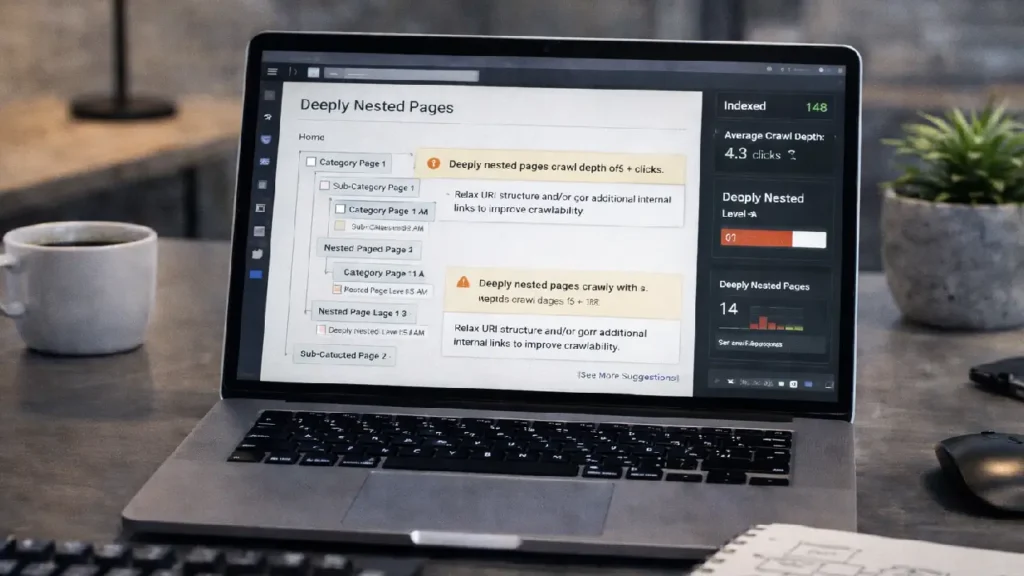
Deeply nested pages are pages located multiple clicks away from the homepage, often buried under several levels of categories or subcategories. While these pages may contain valuable content, search engine bots may have difficulty crawling and indexing them efficiently. Poorly structured websites with deeply nested pages often suffer from crawl inefficiency, slow indexing, and diluted link equity, which can impact SEO performance.
Auditing these pages is a critical part of technical SEO. A proper audit helps ensure that all your content is discoverable, indexable, and able to contribute to your site’s rankings.
Why Deeply Nested Pages Are a Problem
1. Crawl Depth Limits
Search engines allocate a “crawl budget” to each website, representing the number of pages crawled during a given timeframe. Deeply nested pages require more clicks to reach, which increases crawl depth and may prevent search engines from discovering all important pages.
2. Reduced Link Equity
Pages buried deep in the site hierarchy often receive minimal internal link equity. This can reduce their ability to rank and limit the SEO potential of the content.
3. Poor User Experience
Users may struggle to navigate content hidden behind multiple layers of categories or menus. Good UX often correlates with better SEO performance.
4. Indexing Delays
Deep pages may be indexed slowly or inconsistently due to their distance from the homepage and internal linking structure.
For a broader understanding of website structure and SEO, check:
Website Architecture SEO Guide
Steps to Audit Deeply Nested Pages
1. Map Your Site Structure
Create a visual map of your site’s hierarchy to identify how many clicks it takes to reach each page. This will reveal which pages are deeply nested.
- Use tools like Screaming Frog or Sitebulb to crawl your website and export a click-depth report.
- Highlight pages with more than 3–4 clicks from the homepage as candidates for restructuring.
2. Evaluate Crawl Accessibility
Check which pages are being crawled by search engines and which may be overlooked.
- Review your Google Search Console crawl stats.
- Use server log analysis to identify pages rarely crawled by bots.
Pages rarely accessed by bots may require additional internal links or structural changes.
3. Analyze Internal Linking
Assess the internal linking pointing to deeply nested pages.
- Are important pages linked from high-authority pages?
- Do breadcrumbs exist to improve hierarchy navigation?
- Are there contextual links within related content?
Adding links from relevant pages increases crawl efficiency and distributes link equity. For example, linking deeply nested category pages to relevant guides like Pagination SEO Guide can improve visibility.
4. Prioritize High-Value Pages
Not every deep page requires restructuring. Identify high-value pages with significant traffic, conversions, or keyword potential and prioritize improving their accessibility.
- Use Google Analytics to find pages with organic traffic.
- Check keyword rankings to identify pages with SEO potential.
5. Improve Navigation and Breadcrumbs
- Include deep pages in navigation menus or footers where relevant.
- Implement breadcrumbs that link back to higher-level categories.
- Ensure consistent anchor text to improve relevance signals.
6. Monitor Page Indexing
After restructuring or adding links, monitor how these pages are indexed.
- Use Google Search Console URL Inspection to check index status.
- Track indexing over time to ensure improvements are recognized.
7. Consider URL Restructuring
In some cases, restructuring URLs to reduce depth can be beneficial.
- Example: Instead of
/category/subcategory/sub-subcategory/product, consider/category/productwhere feasible. - Redirect old URLs to preserve link equity and prevent broken links.
Tools for Deeply Nested Page Audits
- Screaming Frog – click-depth and internal linking analysis
- Ahrefs Site Audit – crawl efficiency reports
- Google Search Console – crawl stats, coverage, and indexing reports
- Sitebulb – visual site architecture and click-depth analysis
Using these tools ensures you identify and address pages that are hidden too deep in the structure.
Best Practices for SEO of Deep Pages
- Keep all important pages within 3 clicks from the homepage.
- Use breadcrumbs for hierarchical navigation.
- Implement contextual links from relevant content.
- Monitor crawl stats and indexing regularly.
- Avoid creating overly deep category structures unnecessarily.
For related SEO insights, see:
Structured Data Implementation Guide
Summary
Auditing deeply nested pages is essential to ensure search engines can crawl, index, and rank all valuable content. By mapping your site, analyzing internal links, prioritizing high-value pages, and improving navigation, you can optimize crawl efficiency and boost SEO performance.
Key Takeaways:
- Identify pages buried deep in the site hierarchy.
- Add contextual and navigation links to improve accessibility.
- Use breadcrumbs and structured navigation.
- Monitor indexing to measure improvements.
- Restructure URLs for better usability when needed.
Optimizing deeply nested pages ensures no valuable content is hidden from search engines, enhancing your website’s overall SEO and user experience.
Need Help Auditing Your Website?
If your website has deeply nested pages or suffers from crawl inefficiency, our technical SEO experts can help. Contact us today.