In today’s fast-paced business world, waiting weeks for market research insights just isn’t an option. Traditional methods are slow, expensive, and often outdated. The good news? AI-powered market research tools are here to change the game.
AI tools provide instant insights, track customer behavior in real-time, and help you spot emerging trends before your competition does. Whether you’re a startup or a growing brand, AI makes market research faster, smarter, and more affordable.
In this blog, we’ll walk you through some of the best AI market research tools that will keep you ahead of the curve and help you make confident, data-driven decisions.
What Are AI Market Research Tools?
AI market research tools are smart software that use artificial intelligence and machine learning to gather and analyze data. Instead of spending hours going through spreadsheets or paying for expensive research firms, these tools do the heavy lifting for you. They can quickly pull insights from social media, customer feedback, surveys, and more.
These tools don’t just collect data—they also spot patterns, understand the emotions behind customer responses, and even predict what your customers might want next. Think of it like having a super-smart assistant that works 24/7, always knowing where to find the answers you need. AI-driven tools can also help with AI keyword research and AI content writing, ensuring that your marketing strategies and content are optimized for maximum impact.
Why AI Market Research is a Game-Changer
In today’s fast-moving digital world, timing is everything. AI tools are completely changing the way businesses approach market research by:
- Real-time Consumer Insights: AI provides instant data on customer actions, letting you track trends as they happen, so you can make quick decisions.
- Automated Surveys & Analysis: AI automates the entire process, from distributing surveys to analyzing responses, speeding up the time it takes to get insights.
- Sentiment Analysis: AI can read customer feedback to detect emotions, helping you understand not just what customers are saying, but how they feel.
- Early Trend Detection: AI identifies emerging trends by analyzing massive amounts of data, giving you the advantage of acting before they become popular.
- Cost-effective & Accurate Research: AI cuts costs by replacing agencies and manual work, providing accurate insights. It also streamlines the SEO workflow by automating tasks like keyword research, content optimization, and performance tracking.
Whether you’re a startup founder or a marketing manager, AI market research tools help you make smarter, faster, and more confident decisions.
15 Best AI Market Research Tools
1. Remesh
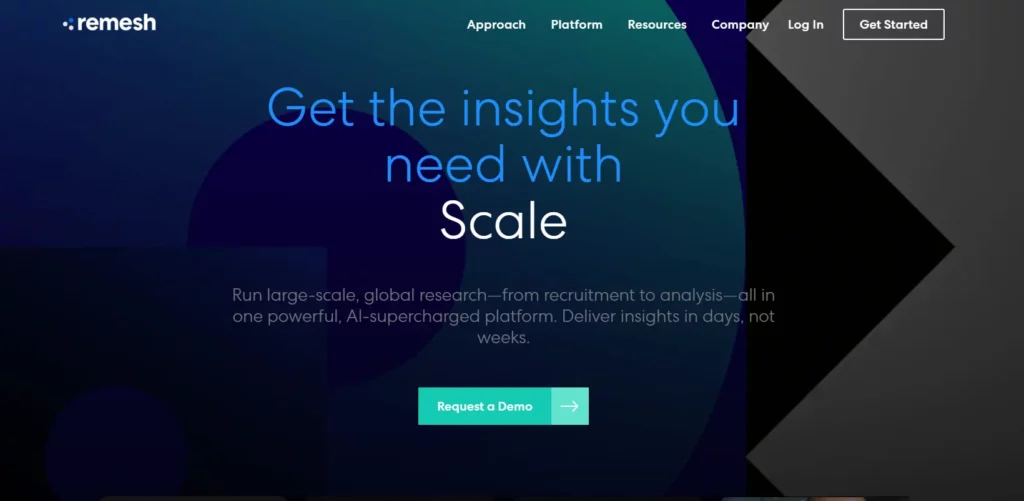
Remesh is an AI-driven platform that allows businesses to conduct live, real-time focus groups. Unlike traditional methods, which can take weeks to analyze, Remesh provides instant insights, enabling businesses to gather actionable feedback quickly. It’s perfect for companies looking to make fast, informed decisions based on what their audience thinks right now.
Key Features:
- Collect instant feedback in real-time, just like a live focus group.
- Use AI to analyze sentiment, emotions, and behavioral trends.
- Predict future customer actions based on current interactions.
- Conduct large-scale focus groups without geographic limits.
- Understand deeper emotions behind customer opinions.
Pros:
- Real-time feedback, faster than traditional focus groups.
- Conduct large focus groups without physical presence.
- Interactive setup boosts engagement for quality feedback.
Cons:
- Focuses on qualitative insights, lacking detailed numerical data.
- Can be expensive for smaller businesses.
How It Helps in Market Research
Remesh is ideal for businesses seeking quick, actionable insights. Whether for product feedback, understanding customer emotions, or predicting behaviors, it provides real-time results and large-scale reach, helping businesses make fast, informed decisions without the delays of traditional research.
2. Neurons
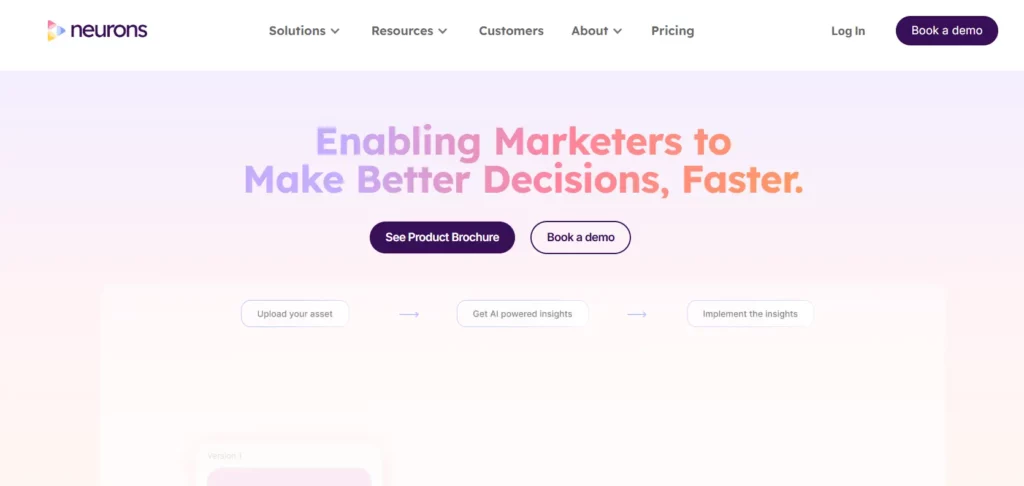
Neurons uses AI and biometric analysis to provide deep insights into consumer behavior. Through facial coding, eye tracking, and emotion detection, it uncovers how consumers emotionally respond to products, ads, and brands, offering valuable data beyond traditional methods.
Key Features:
- Measures emotional reactions through facial expressions.
- Tracks attention and engagement via eye-tracking.
- Provides subconscious insights into consumer behavior.
- Offers immediate insights for quick decision-making.
- Analyzes customer reactions to ads, products, and brands in real time.
Pros:
- Provides scientifically backed emotional insights.
- High accuracy in measuring consumer reactions.
- Real-time feedback for faster adjustments.
Cons:
- Focuses more on emotional responses than conscious opinions.
- Expensive for smaller businesses with tight budgets.
How It Helps in Market Research
Neurons help businesses understand subconscious emotional drivers behind consumer behavior. Its insights enable companies to tailor products, ads, and strategies for better consumer engagement and success.
3. Crayon
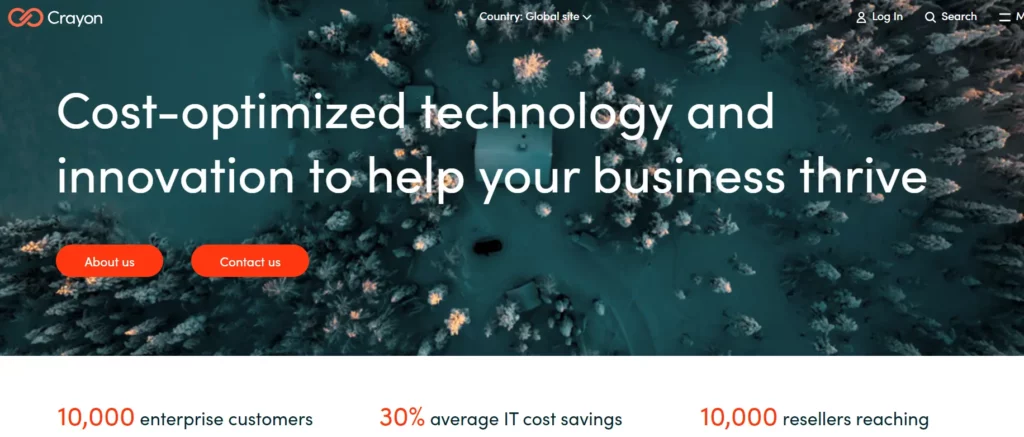
Crayon uses AI to track competitive intelligence and provides insights into your competitors’ activities, strategies, and market changes. It helps businesses stay ahead by offering real-time data on competitors’ websites, pricing, and product launches.
Key Features:
- Monitors competitors’ websites, social media, and product offerings.
- Tracks changes in pricing, features, and promotions.
- Provides detailed insights on market shifts and trends.
- Offers real-time alerts on competitor activities.
- Analyzes competitor content strategy and performance.
Pros:
- Comprehensive competitor tracking.
- Real-time alerts on market changes.
- Provides detailed competitive intelligence.
Cons:
- Can be overwhelming with the sheer volume of data.
- Requires time to set up and configure.
How It Helps in Market Research
Crayon helps businesses keep an eye on competitors, providing valuable insights into how the market is evolving and where to focus marketing efforts.
4. Qualtrics
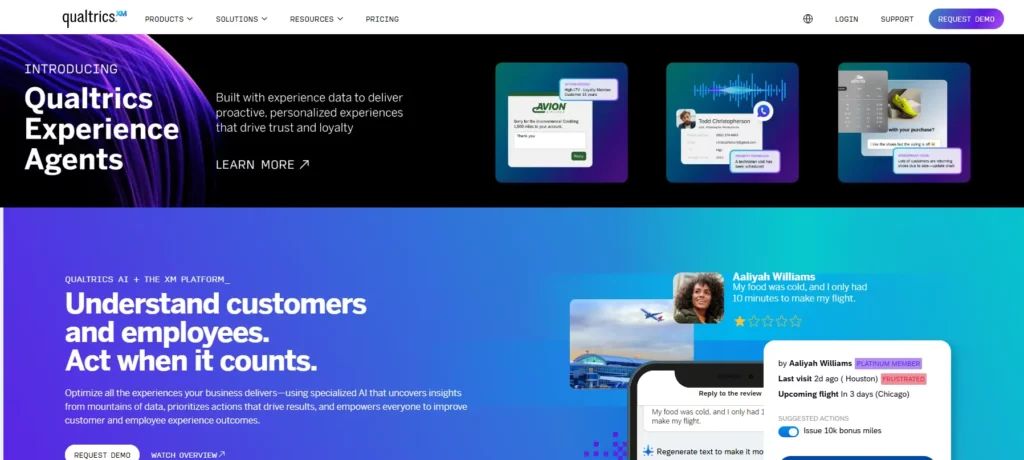
Qualtrics is a powerful research platform that leverages AI to help businesses collect, analyze, and act on customer insights. It allows for advanced survey creation, sentiment analysis, and market segmentation.
Key Features:
- AI-driven survey creation and analysis.
- Advanced sentiment analysis to understand customer emotions.
- Real-time reporting and insights.
- Market segmentation and audience profiling.
- Integration with a wide range of platforms and tools.
Pros:
- Highly customizable surveys and insights.
- Strong data analysis capabilities.
- Integrates with various marketing platforms.
Cons:
- Can be complex for beginners.
- High price point for small businesses.
How It Helps in Market Research
Qualtrics helps businesses gather actionable customer data to refine marketing strategies, optimize product offerings, and improve customer experience.
5. Lexalytics
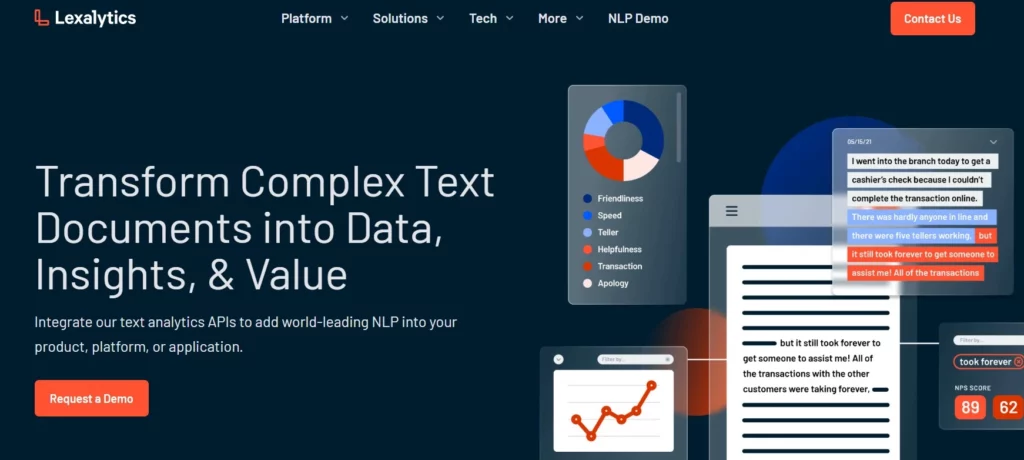
Lexalytics is a powerful text analytics platform that provides deep sentiment analysis and natural language processing (NLP). It’s widely used in industries like healthcare, finance, and marketing for understanding customer opinions.
Key Features:
- Advanced sentiment analysis and theme extraction
- Supports multiple languages
- On-premise and cloud deployment options
- Text mining for emails, surveys, and call center transcripts
- Industry-specific models available
Pros:
- Highly customizable for niche industries
- Offers detailed and accurate sentiment breakdown
- Scalable for enterprise-level data
Cons:
- Steeper learning curve for non-technical users
- Pricing may be high for small businesses
How It Helps in Market Research
Lexalytics helps turn massive amounts of textual feedback into structured insights. This allows marketers to understand trends, detect issues, and fine-tune strategies based on customer sentiment.
6. Talkwalker
Talkwalker is a leading consumer intelligence platform that combines AI-powered sentiment analysis with social listening. It helps brands monitor, analyze, and act on online conversations in real time.
Key Features:
- Real-time social listening and sentiment analysis
- Tracks conversations across social media, news sites, blogs, and forums
- Visual analytics and customizable dashboards
- Competitive benchmarking and trend prediction
- Multilingual support
Pros:
- Extremely comprehensive coverage across platforms
- Offers predictive insights and alerts
- Great for brand reputation management
Cons:
- Can be expensive for small teams
- Requires onboarding time to utilize full capabilities
How It Helps in Market Research
Talkwalker uncovers real-time trends and public sentiment, enabling businesses to make informed marketing decisions, manage brand perception, and respond to customer needs proactively.
7. SurveyMonkey
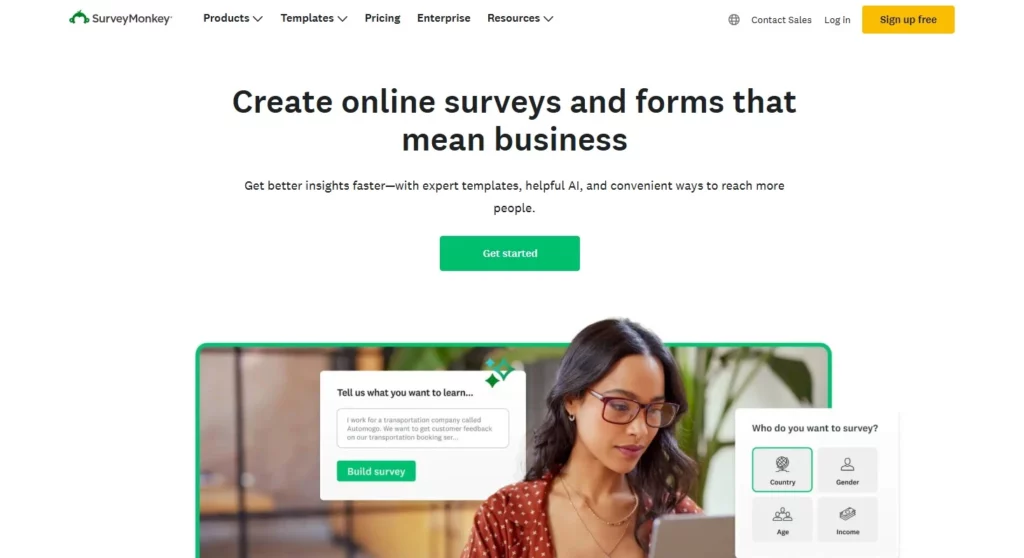
SurveyMonkey uses AI to analyze survey responses, offering actionable insights to improve products, services, and customer satisfaction.
Key Features:
- AI-driven survey analytics.
- Customizable templates for market research.
- Real-time reporting and results.
- Audience segmentation for targeted insights.
- Integration with various CRM and marketing platforms.
Pros:
- Simple and intuitive interface.
- Good range of survey templates.
- Easy integration with third-party tools.
Cons:
- Limited customization on lower-tier plans.
- Can become costly for advanced features.
How It Helps in Market Research
SurveyMonkey allows businesses to gather data directly from their target audience, providing insights into market trends, customer satisfaction, and product feedback.
8. Survicate
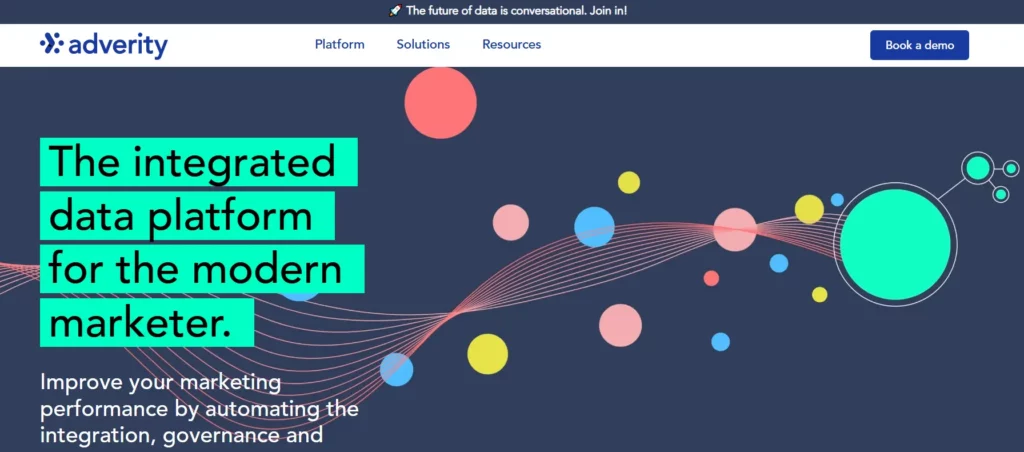
Survicate is a survey tool that allows businesses to collect customer feedback across various touch points like websites, email, and mobile apps. It uses AI to analyze sentiment from these responses.
Key Features:
- In-app surveys and email surveys
- AI-powered sentiment analysis for open-ended responses
- Integration with other platforms like Slack, HubSpot, and Salesforce
- Real-time feedback analysis
Pros:
- Easy to deploy on websites and apps
- Customizable survey templates
- Works well for both qualitative and quantitative data
Cons:
- Limited in terms of more advanced analytics
- Some integrations are paid features
How It Helps in Market Research
Survicate helps businesses gather real-time feedback from customers and automatically analyzes sentiment, allowing companies to take immediate action based on customer insights.
9. Adverity
Adverity is an AI-powered marketing data analytics platform that integrates data from multiple sources to provide comprehensive insights into marketing campaigns and performance.
Key Features:
- Integrates data from various marketing platforms.
- AI-driven insights into campaign performance.
- Real-time reporting and dashboard capabilities.
- Customizable reporting templates for different needs.
- Predictive analytics for future campaign performance.
Pros:
- Centralized marketing data hub.
- Powerful campaign analysis tools.
- Provides actionable performance insights.
Cons:
- Complex setup for new users.
- Can be expensive for smaller businesses.
How It Helps in Market Research
Adverity helps businesses analyze marketing campaign data, providing insights into performance and allowing for adjustments to improve marketing effectiveness.
10. HubSpot
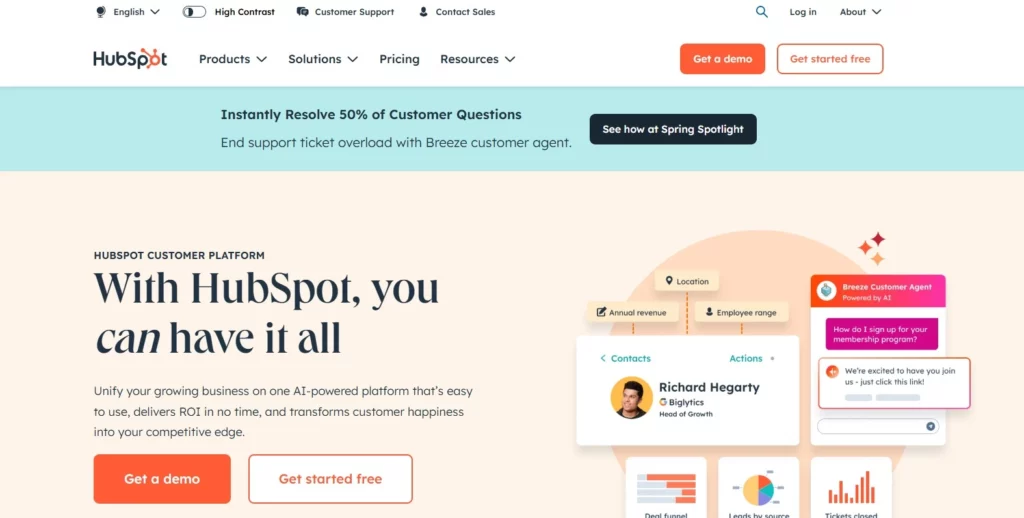
HubSpot uses AI to provide marketing automation, CRM, and analytics tools. It helps businesses optimize customer acquisition and retention through insights gained from marketing data.
Key Features:
- AI-driven CRM and marketing automation.
- Predictive analytics for lead generation.
- Real-time customer data analysis.
- Automated email campaigns and workflows.
- Customizable reporting for different marketing goals.
Pros:
- Comprehensive marketing and CRM tools.
- Easy-to-use interface.
- Great for businesses looking to optimize lead generation.
Cons:
- Can be overwhelming with numerous features.
- Expensive for smaller businesses.
How It Helps in Market Research
HubSpot offers insights into customer behavior, allowing businesses to fine-tune their marketing strategies and improve customer acquisition and retention.
11. Brandwatch
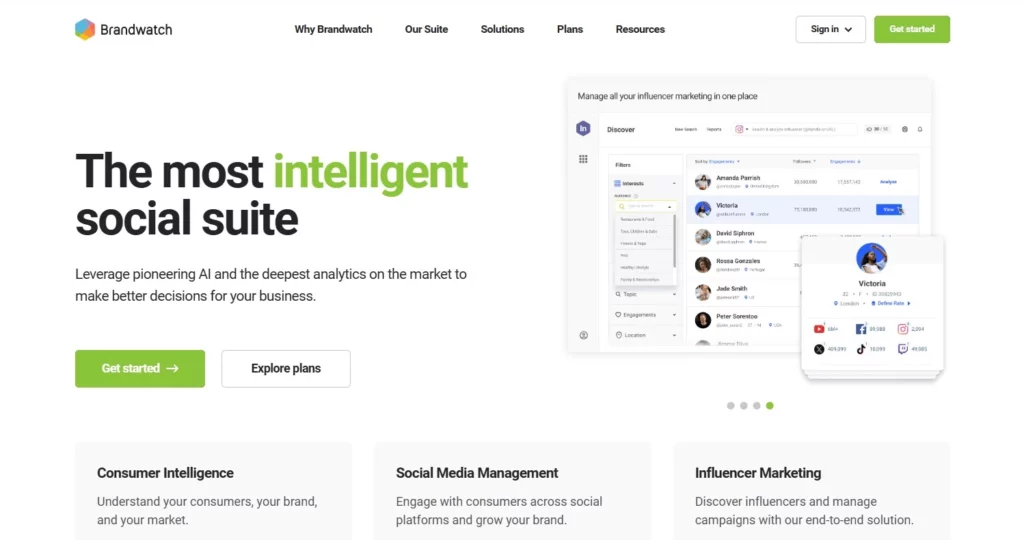
Brandwatch is a social listening and analytics platform that uses AI to track consumer sentiments and online trends. It provides businesses with valuable insights into how customers feel about their brand or products.
Key Features:
- AI-powered sentiment analysis.
- Real-time monitoring of social media mentions.
- Detailed consumer insights and trend reports.
- Historical data analysis for long-term trends.
- Actionable insights for improving brand reputation.
Pros:
- Powerful social listening tools.
- Helps businesses track online conversations.
- Actionable insights for improving brand reputation.
Cons:
- Complex user interface.
- High cost for smaller businesses.
How It Helps in Market Research
Brandwatch helps businesses track online conversations and consumer sentiment, providing insights into how the public perceives their brand or product.
12. Repustate
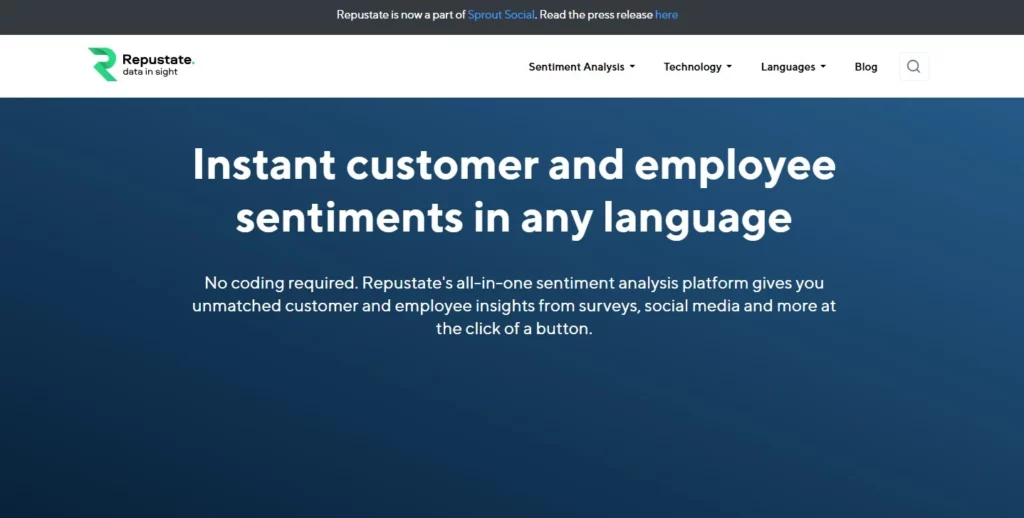
Repustate is a sentiment analysis and text analytics platform designed to analyze customer feedback in multiple languages. It’s commonly used in healthcare, finance, retail, and media.
Key Features:
- Multilingual sentiment and intent analysis
- Works with text, audio, and video (including voice and transcripts)
- Industry-specific models (e.g., healthcare, finance)
- Real-time insights and custom dashboards
- API and on-premise options available
Pros:
- Supports 20+ languages
- Handles multiple types of media, not just text
- Customizable for industry-specific use cases
Cons:
- Smaller company, may lack some enterprise-level integrations
- UI could be more modern
How It Helps in Market Research
Repustate allows businesses to analyze reviews, support calls, and surveys to understand sentiment, helping you adapt messaging, improve products, and enhance customer satisfaction.
13. Latana
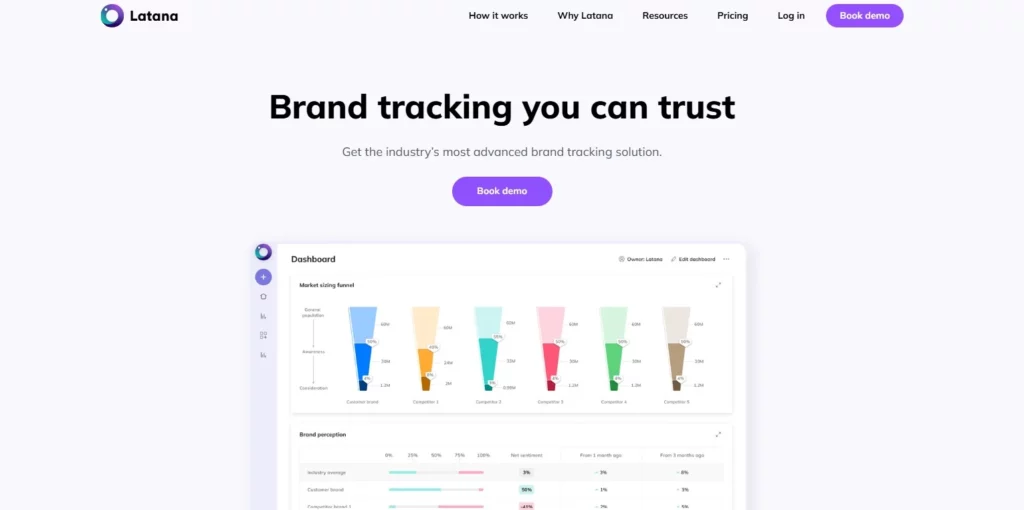
Latana is an AI-driven brand tracking platform that helps you measure brand awareness, perception, and audience insights at scale. It uses advanced analytics to show how different segments view your brand over time, helping you make smarter marketing and branding decisions with confidence.
Key Features:
- Tracks brand awareness, consideration, and preference.
- Uses machine learning to clean and interpret survey data.
- Offers granular audience segmentation insights.
- Visualizes trends across time and demographics.
- Integrates with other platforms for deeper analysis.
Pros:
- Accurate brand tracking backed by AI.
- Insights help improve brand strategy.
- Easy-to-understand dashboards and reports.
Cons:
- Primarily focused on brand metrics, not full market research.
- May require expertise to interpret segmented data.
How It Helps in Market Research
Latana provides brand insights that help companies understand how they’re perceived and how those perceptions shift over time—ideal for long-term brand strategy.
14. Suzy
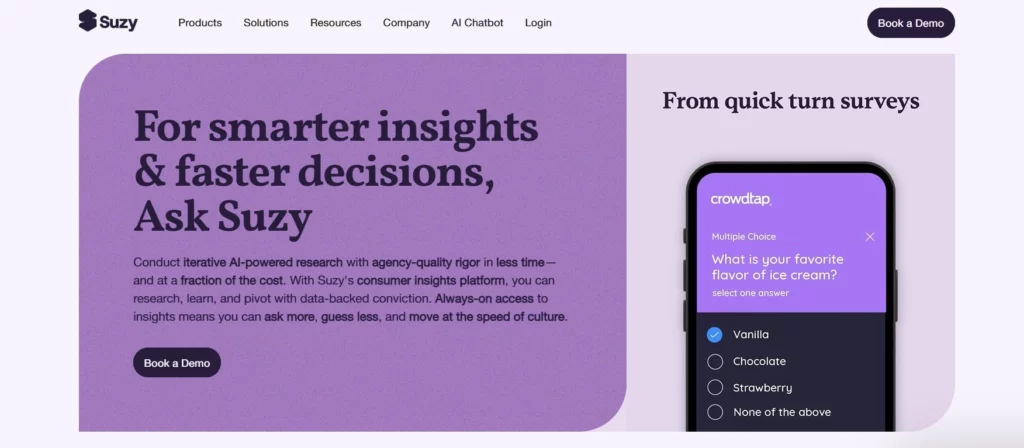
Suzy is an AI-powered consumer research platform that lets brands launch real-time surveys and get quick feedback from their target audience. It’s designed to validate ideas, test products, and understand consumer opinions—within minutes, not days. Suzy connects you with verified respondents, making it easier to gather accurate, on-demand insights that guide smarter business decisions.
Key Features:
- Instant access to a large, on-demand consumer panel.
- Run targeted surveys with specific demographics.
- AI helps analyze responses for quick decision-making.
- Offers visual reports and heatmaps.
- Supports A/B testing for messaging or product concepts.
Pros:
- Get quick answers from real consumers.
- Easy to launch surveys without research experience.
- Ideal for testing marketing ideas or product features.
Cons:
- Less depth in qualitative insights.
- Costs may rise with frequent use or niche targeting.
How It Helps in Market Research
Suzy accelerates research by letting businesses ask the right people, the right questions, at the right time—perfect for testing concepts and validating ideas.
15. Quantilope
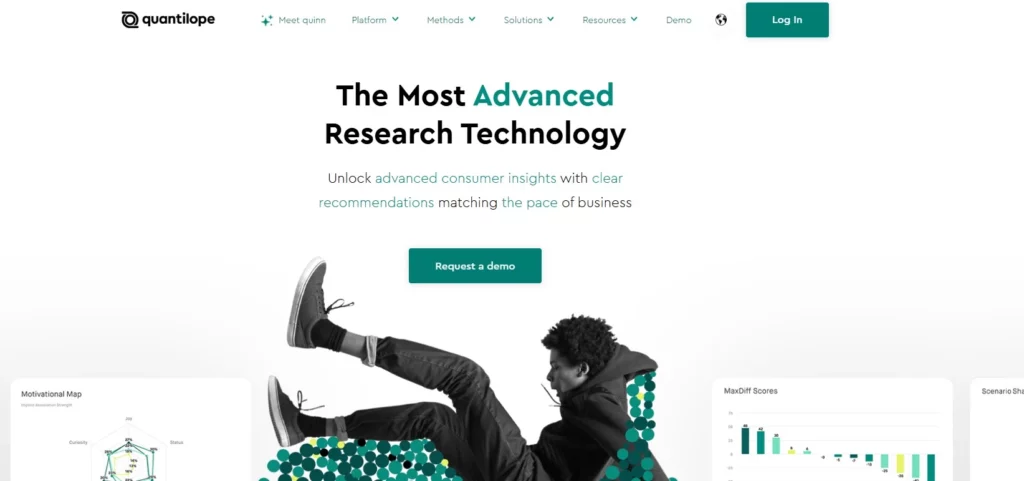
Quantilope is an AI-driven platform that simplifies complex consumer research. It automates methods like segmentation and conjoint analysis, making it easier and faster to gain meaningful insights. Ideal for brands that want deep data without delays.
Key Features:
- Automates complex research methods like conjoint analysis and segmentation.
- Offers customizable survey templates for quick setup.
- Real-time dashboards to monitor responses and trends.
- AI analyzes data to uncover key drivers behind decisions.
- Integrates easily with other tools like SPSS, Tableau, and Excel.
Pros:
- Speeds up the entire research process from survey to insight.
- Offers deep analytics without needing a data science background.
- Great balance between qualitative and quantitative research.
Cons:
- May have a learning curve for beginners.
- Advanced features can be pricey for smaller teams.
How It Helps in Market Research
Quantilope enables businesses to conduct complex studies quickly, helping them uncover what really drives consumer choices—perfect for faster product and marketing decisions.
Conclusion
AI-powered market research tools are no longer a luxury—they’re a necessity for any business that wants to stay competitive in 2025 and beyond. These tools help you cut through the noise, understand your audience better, and make faster, smarter decisions without the guesswork. Whether you’re testing a new product, exploring market trends, or fine-tuning your marketing strategy, AI gives you the edge you need.
So, if you’re still relying on outdated methods, now’s the time to level up. With the right AI tools in your corner, market research doesn’t have to be complicated—it can be quick, accurate, and surprisingly affordable.