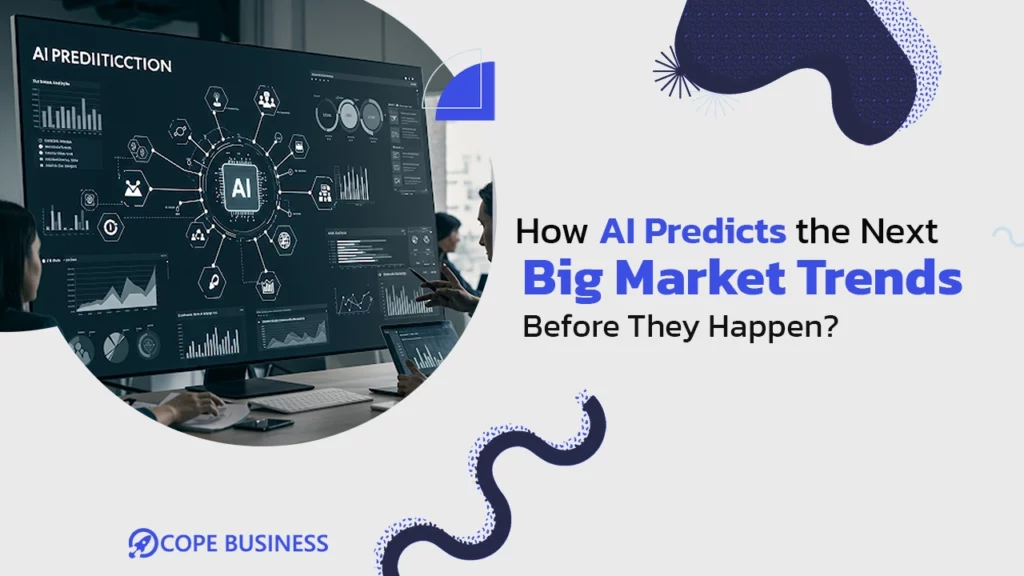
Imagine being able to predict what consumers will want before they even know it themselves. That’s the power AI brings to market trend analysis. Businesses no longer need to rely solely on gut feeling or outdated data. With AI, companies can forecast market trends faster, more accurately, and with actionable insights.
This blog dives deep into how AI predicts the next big market trends and how you can use it to stay ahead of your competitors.
What Is Market Trend Prediction?

Market trend prediction refers to the process of analyzing various forms of data to identify patterns that signal future shifts in consumer behavior, product demand, or industry changes. Traditionally, businesses have used manual analysis, historical data interpretation, and some guesswork. But with AI, the game has changed. AI can process vast amounts of data from multiple sources, helping businesses predict shifts in search terms, social media engagement, and even local SEO patterns that would otherwise go unnoticed.
How AI Spots Trends Before Anyone Else
Artificial Intelligence, particularly machine learning and natural language processing (NLP), has revolutionized the way businesses interpret data. Here’s how:
- Machine Learning Algorithms: These analyze historical and real-time data to recognize patterns and predict future outcomes. The more data they process, the smarter they get.
- Natural Language Processing (NLP): NLP helps AI understand sentiment, keywords, and context from customer reviews, social media, news articles, and more.
- Predictive Analytics: AI uses current and historical data to forecast what will likely happen next in the market.
These technologies allow businesses to make informed decisions faster and with greater accuracy.
Types of Data AI Uses to Predict Trends
AI pulls from diverse datasets to form a complete picture. Some common sources include:
- Social Media Trends – Platforms like Facebook, Instagram, and TikTok offer real-time insights into what people are talking about, providing valuable signals for social media marketing campaigns.
- Search Engine Queries – Google Trends and search volumes reveal rising topics, with AI keyword research tools identifying emerging keywords.
- E-commerce Behavior – User purchases, reviews, and wish lists help indicate buying intent.
- News & Media Analysis – AI scans articles and press releases to identify trending topics.
- Customer Feedback & Reviews – Analyzing what customers are saying (and how they’re saying it) gives valuable sentiment data.
- Financial & Stock Market Data – AI tracks investments and market fluctuations for indicators of broader economic shifts.
By integrating these datasets, AI creates a multidimensional view of market behavior.
How AI Models Work Behind the Scenes
AI’s ability to predict trends relies on a multi-step process that continuously learns, adapts, and improves. Here’s a breakdown:
- Data Collection: AI gathers vast amounts of data, both structured (like spreadsheets) and unstructured (like social media posts).
- Data Cleaning and Preprocessing: Raw data is cleaned—duplicates removed, errors fixed, and formatted consistently for analysis.
- Pattern Recognition: Machine learning models examine this refined data to uncover trends, correlations, and behavioral patterns. For example, a surge in TikTok mentions often corresponds with increased product searches.
- Trend Forecasting: Once patterns are recognized, AI uses predictive modeling to forecast future trends. It simulates various scenarios to predict how the market might react under different conditions.
- Continuous Learning: As new data arrives, AI learns and refines its predictions. This feedback loop helps the model stay accurate and relevant over time.
Real-World Examples of AI Predicting Trends
- Netflix & Content Recommendations – Netflix uses AI to predict which shows or genres will trend next by analyzing viewer behavior, watch times, and preferences.
- Amazon Product Forecasting – Amazon’s AI suggests trending products based on buying patterns and regional interest.
- Fashion Retailers – Brands like H&M and Zara use AI to analyze social media photos and influencer content to stay on top of fashion trends.
- Spotify – By studying user listening habits, Spotify predicts music trends and curates personalized playlists that often go viral.
These examples prove that AI can not only detect trends—it can shape them.
Benefits of Using AI for Market Trend Prediction
- Faster Decision-Making: Real-time data analysis means you can act before the trend peaks.
- Cost Efficiency: Cut down on manual research and guesswork.
- Customer-Centric Strategy: Develop products and services your audience already wants.
- Competitive Advantage: Spot opportunities before your rivals do.
- Risk Mitigation: Forecast downturns or shifts in consumer sentiment early.
Tools That Help You Leverage AI for Trend Forecasting
Here are some powerful AI-driven tools you can explore:
- Google Trends + Bard AI: Analyze real-time search trends and pair them with contextual AI insights.
- Crayon: Monitors your competitors and market signals in real-time.
- SparkToro: Reveals what your audience reads, listens to, and talks about online.
- Exploding Topics: Identifies rapidly growing topics before they hit the mainstream.
- ChatGPT with Plugins: Use data scraping plugins or link it with tools like Zapier to analyze large-scale data for trend signals.
These tools make it easier for small and mid-size businesses to tap into AI-powered insights.
Challenges and Limitations of AI in Trend Prediction
While AI is powerful, it’s not foolproof:
- Data Quality: Inaccurate or biased data leads to flawed predictions.
- Overfitting Models: Too much reliance on historical patterns can miss novel trends.
- Interpretability: Complex AI models can be hard to interpret, making it difficult to explain predictions.
- Privacy Concerns: Use of customer data must comply with regulations like GDPR.
Being aware of these limitations helps in balancing AI insights with human intuition.
How Businesses Can Use AI-Powered Trends Effectively
AI-powered trends provide businesses with valuable, real-time insights. Here’s how companies can use them effectively:
- Product Development: AI predicts market demand, helping businesses create products that match upcoming consumer preferences. For example, a clothing brand can anticipate which colors or styles will trend.
- Marketing Strategy: By analyzing social media and search data, AI helps businesses align campaigns with rising interests. For instance, eco-conscious brands can target consumers with Earth Day-themed campaigns.
- Content Creation: AI helps businesses identify trending topics, ensuring they create content that resonates with their target audience, boosting SEO rankings.
- Inventory Management: AI predicts which products will be in high demand, helping businesses stock up accordingly.
- Customer Engagement: AI personalized messaging by analyzing consumer behavior, making marketing campaigns more effective.
By implementing these strategies, businesses can stay ahead of market shifts and make faster, more informed decisions.
The Future of AI in Trend Forecasting
AI’s trend prediction capabilities are only getting smarter. Here’s what’s coming next:
- Hyper-Personalized Forecasting: AI will soon predict trends specific to micro-niches or even individuals.
- Real-Time Adjustments: Businesses can dynamically shift offerings as data updates live.
- Voice & Visual Data Inclusion: AI will pull insights from podcasts, YouTube, TikTok, and even facial expressions.
- AI + Human Collaboration: The best insights will come from a combination of machine accuracy and human intuition.
Staying updated with these advancements ensures long-term success and adaptability.
Conclusion
In a world where markets shift by the minute, businesses can’t afford to fly blind. AI offers a fast, smart, and scalable way to detect emerging trends—turning chaos into clarity.
From consumer behavior to tech breakthroughs, financial shifts to cultural movements—AI can scan it all, spot the signals early, and give you the insights needed to lead, not follow.
The companies that embrace AI trend detection today will be the ones setting the trends tomorrow.