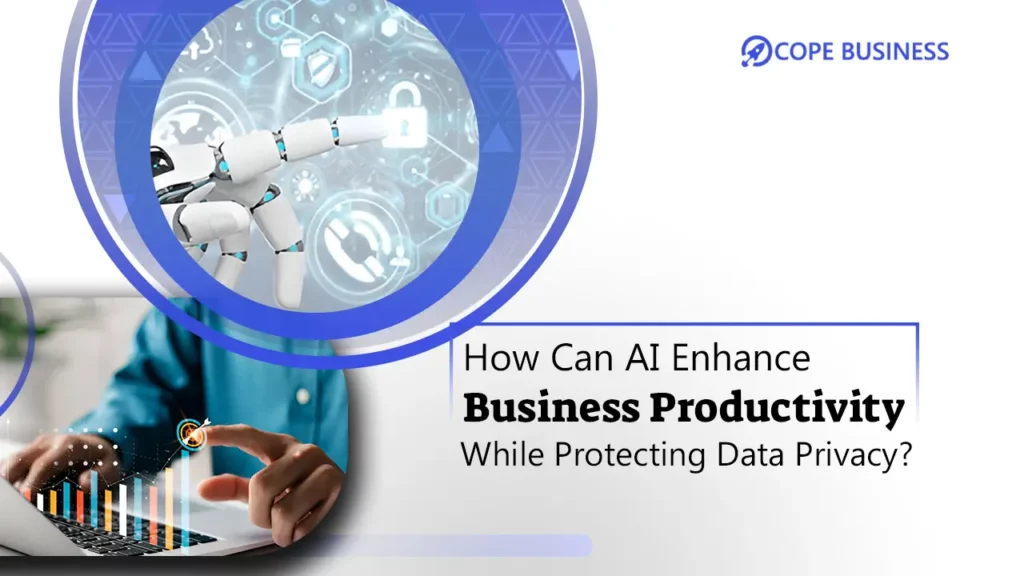
In today’s fast-paced digital world, Artificial Intelligence (AI) is no longer a futuristic concept—it’s a real, transformative force in business. From automating repetitive tasks to delivering smarter decision-making, AI is helping companies become more productive and efficient. But with this power comes a major concern: data privacy.
Business owners, especially those operating online, face a critical challenge—how to use AI to improve productivity without putting sensitive information at risk. This blog breaks down how AI can be both a productivity booster and a privacy protector.
Why Businesses Are Turning to AI for Productivity

Before we explore the privacy side, let’s first look at how AI enhances business productivity:
1. Automating Routine Tasks
AI excels at handling repetitive tasks, freeing up valuable human resources for higher-level, strategic work. Tasks like data entry, customer support, scheduling, and inventory management are automated by AI tools like chatbots and virtual assistants, improving operational efficiency.
Example: AI-powered email assistants like Superhuman or Google’s Smart Reply help professionals manage inbox overload, saving time and improving productivity.
2. Smart Decision-Making with Data
AI analyzes vast amounts of data in seconds, generating actionable insights that would take humans days to uncover. This enables businesses to make informed decisions more quickly, improving strategic planning and operations.
Example: Sales teams use AI-driven CRMs like Salesforce Einstein, which predicts which leads are more likely to convert, helping companies close deals with less effort.
3. Personalized Customer Experience
AI helps businesses create personalized experiences for customers by analyzing behavior, preferences, and purchase history. Tailored recommendations and communications lead to higher engagement and stronger customer relationships.
Example: E-commerce platforms like Amazon use AI to suggest products based on a customer’s browsing and purchase history, which increases conversions and customer loyalty.
4. Predictive Maintenance & Efficiency
Industries like manufacturing and logistics use AI to predict machine failures before they happen, reducing downtime and maintenance costs.
Example: General Electric uses AI to monitor its equipment and schedule proactive maintenance, saving millions annually by avoiding costly repairs and downtime.
The Other Side of the Coin: Data Privacy Concerns
With great power comes great responsibility. AI requires large datasets to operate effectively, but many of the data points AI systems use are highly sensitive—customer profiles, purchase history, financial data, health records, and more. This raises a critical concern: How can businesses leverage AI for productivity without compromising data privacy?
Here are some of the top data privacy risks businesses face when using AI:
- Unauthorized Data Collection: AI systems may collect more data than necessary, creating security risks.
- Poorly Secured Databases: If data isn’t properly encrypted, sensitive information can be exposed.
- Bias and Discrimination in Algorithms: If data used to train AI models is biased, the results may perpetuate discrimination.
- Regulatory Non-Compliance: Failure to comply with data protection laws like GDPR, CCPA, and HIPAA can result in penalties.
- Lack of Transparency in AI Decision-Making: The “black box” issue where AI decisions are not easily understandable by users can create trust issues.
Without careful management, AI systems can inadvertently compromise user privacy, damage brand reputation, and expose businesses to legal risks.
How Can Businesses Use AI Responsibly (Without Compromising Productivity)?

Now, the key question is: How can businesses balance AI’s productivity benefits with the need to protect data privacy? Here are proven ways businesses can do so:
1. Adopt Privacy-By-Design AI Tools
Choose AI systems that have privacy features built into the core design rather than as an afterthought. Look for tools that:
- Encrypt data at rest and in transit
- Anonymize or pseudonymize personal data
- Offer user consent mechanisms
- Avoid storing unnecessary data
Tip: If your AI tool handles customer data, ensure it complies with regulations like GDPR (Europe) or CCPA (California).
2. Use Federated Learning to Train AI
Federated learning allows AI models to learn from data without transferring it to a central server. The AI is trained locally (e.g., on a device or browser), and only updates to the model are shared. This reduces the risk of exposing sensitive data while still benefiting from AI’s power.
Why this matters:
- Sensitive data never leaves the device.
- It minimizes the risk of unauthorized access.
- It’s ideal for industries like healthcare, banking, and education.
Example: Google uses federated learning for its Gboard keyboard to learn typing patterns without accessing the actual content of users’ messages.
3. Limit Data Collection to What’s Necessary
Collecting too much data can expose businesses to greater privacy risks. Focus on gathering only the data necessary for your AI to function and ensure that it is used ethically.
Key Actions:
- Collect only essential data for AI functionality.
- Set clear data retention policies.
- Regularly audit and delete old or unused data.
By collecting less data, businesses not only protect privacy but also improve AI performance, as smaller, more relevant datasets are easier to manage and analyze.
4. Use AI to Monitor and Strengthen Privacy Controls
AI can also be used to protect user privacy and prevent data breaches. Some AI tools actively monitor data access and security to safeguard information.
Examples of AI for Privacy:
- Anomaly Detection: AI can alert you to unusual access patterns or potential data breaches.
- Access Management: AI systems can detect unauthorized access attempts and enforce role-based controls.
- Data Masking: AI can automatically alter or hide sensitive data when it’s being used or shared.
Example: Microsoft Azure offers AI-powered tools that detect suspicious logins and prevent identity theft in real-time.
5. Build Transparent AI Models
Transparency builds trust. Users and regulators need to understand how AI makes decisions, especially in high-stakes areas like healthcare or finance.
To ensure transparency, your AI system should:
- Show how decisions are made.
- Offer clear explanations that users can understand.
- Provide users with the ability to opt-out if they’re uncomfortable with AI-driven decisions.
Bonus Tip: Use AI interpretability tools like LIME or SHAP to explain how your AI models make predictions.
6. Stay Compliant with Evolving Data Laws
Data privacy regulations like the GDPR, CCPA, and sector-specific laws (such as HIPAA in healthcare) are constantly evolving. To remain compliant:
- Work closely with legal and compliance experts.
- Use AI tools that are designed with legal frameworks in mind.
- Regularly review and update your data policies to stay current.
Helpful Tools: Tools like OneTrust, TrustArc, and Osano can help automate compliance checks and manage consent.
7. Educate Your Team and Stakeholders
Data privacy is a company-wide responsibility, not just an IT issue. Ensure that your entire team understands how AI works, the privacy risks involved, and how to mitigate them.
Actionable Steps:
- Offer regular training or workshops on AI ethics and data privacy.
- Ensure all departments follow best practices in data handling and security.
The Business Benefits of Responsible AI Use
By using AI responsibly, businesses can unlock several powerful advantages:
- Increased Efficiency: Automation streamlines business processes and boosts productivity.
- Improved Customer Trust: Data privacy and transparency lead to stronger customer loyalty.
- Reduced Risk: Minimizing data privacy risks lowers the chances of data breaches and legal issues.
- Better Decision-Making: Clean, relevant data ensures smarter decisions.
- Competitive Advantage: In a privacy-conscious world, businesses that respect privacy stand out from the competition.
Scaling Digital Marketing with AI Without Losing Trust
Modern businesses are integrating AI into their digital marketing strategies to scale faster, reach more targeted audiences, and automate repetitive tasks. From SEO workflows to personalized email campaigns, AI is transforming how companies operate.
But with increased automation comes a growing concern: How do you maintain data privacy and user trust while optimizing performance?
That’s where businesses are finding value in AI-powered marketing automation that’s built with compliance in mind. When privacy is baked into every layer of your automation tools, you can:
- Improve SEO performance by analyzing user search behavior without collecting excessive data
- Personalize content and campaigns while respecting consent preferences
- Streamline marketing efforts through smart workflows that stay compliant with GDPR, CCPA, and other regulations
- Gain actionable insights without putting sensitive information at risk
This approach allows businesses to automate and optimize marketing—without compromising on ethics or user trust.The future isn’t just about scaling with AI. It’s about doing it responsibly and sustainably, especially in areas like digital marketing, SEO, and customer engagement.
Final Thoughts
AI offers unparalleled opportunities to enhance business productivity, streamline processes, and scale operations. However, businesses must recognize that productivity at the expense of privacy is a short-term gain with long-term consequences.
The most successful businesses today are those that find the balance between innovation and responsibility. Whether you’re a small eCommerce brand or a large B2B company, the formula is simple:
Use AI to automate smartly. Protect user data fiercely.
By implementing privacy-conscious AI solutions, you can grow your business sustainably and earn your customers’ trust in the process. This approach is the future of responsible business growth in the digital age.