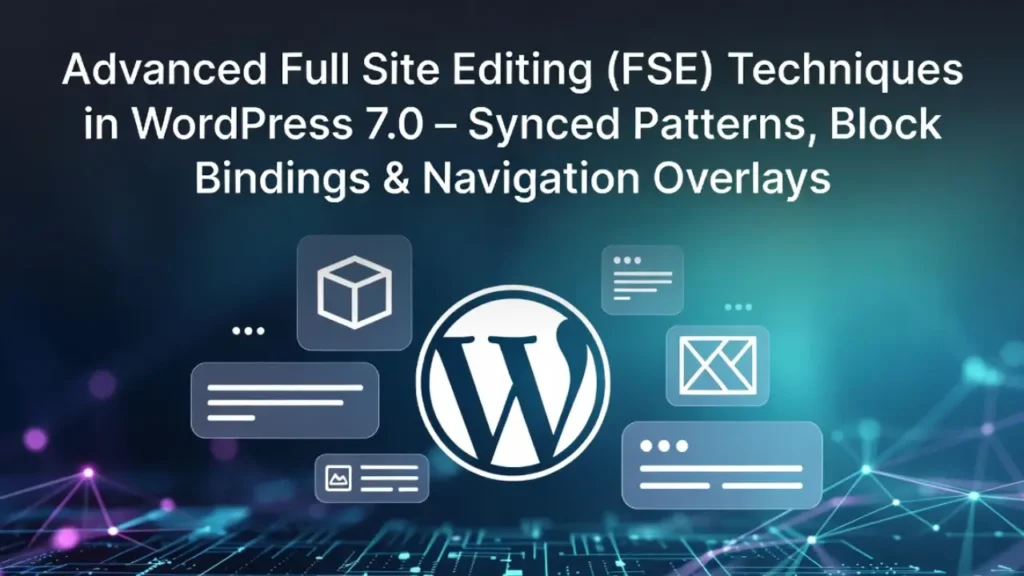
In the rapidly evolving WordPress ecosystem of 2026, Advanced Full Site Editing has become the cornerstone for building highly customizable, performant, and maintainable websites. Whether you manage a large enterprise site, an e-commerce platform, or a content-rich blog, Advanced Full Site Editing empowers you to control every aspect of your design directly within the Site Editor. This in-depth guide dives into the most powerful Advanced Full Site Editing techniques in WordPress 7.0 — focusing on Synced Patterns, Block Bindings, and Navigation Overlays — and shows exactly how to implement them for real-world results.
By mastering Advanced Full Site Editing, you’ll unlock unprecedented design consistency, dynamic content capabilities, and mobile-first navigation control without writing a single line of custom theme code. Let’s explore why Advanced Full Site Editing is a game-changer and how you can start using these professional techniques today.
What Is Advanced Full Site Editing in WordPress 7.0?
Advanced Full Site Editing represents the mature evolution of the block-based site-building experience introduced years ago. In WordPress 7.0, Advanced Full Site Editing goes far beyond basic template editing. You can now design headers, footers, templates, and even mobile-specific elements entirely with blocks, patterns, and global styles.
At its core, Advanced Full Site Editing lets content creators and developers work in the same visual interface. The Site Editor becomes your single source of truth for layout, typography, colors, and functionality. With Advanced Full Site Editing, changes to global styles or patterns propagate instantly across your entire site, saving hours of manual updates.
WordPress 7.0 has supercharged Advanced Full Site Editing with enhanced stability, new template-part areas, and deeper integration between blocks and dynamic data. These improvements make Advanced Full Site Editing suitable for even the most complex projects.
Key Benefits of Advanced Full Site Editing in WordPress 7.0
Adopting Advanced Full Site Editing delivers measurable advantages that traditional theme development simply cannot match.
First, Advanced Full Site Editing dramatically improves design consistency. Synced Patterns ensure that every instance of a footer, CTA banner, or hero section stays perfectly aligned.
Second, Advanced Full Site Editing boosts development speed. Developers no longer need to maintain separate PHP template files; everything lives inside the block ecosystem.
Third, Advanced Full Site Editing enhances performance. Block themes built with Advanced Full Site Editing load faster because the editor generates optimized markup and leverages modern rendering techniques.
Fourth, Advanced Full Site Editing simplifies team collaboration. Real-time editing features pair perfectly with Advanced Full Site Editing workflows.
Fifth, Advanced Full Site Editing future-proofs your site. As new blocks and features arrive in future releases, your Advanced Full Site Editing setup adapts seamlessly.
These benefits explain why thousands of agencies and enterprises have fully migrated to Advanced Full Site Editing in 2026.
Synced Patterns: The Powerhouse of Advanced Full Site Editing
One of the most transformative features in Advanced Full Site Editing is the enhanced Synced Patterns system. In WordPress 7.0, Synced Patterns (formerly reusable blocks) now support contextual editing, pattern overrides, and content-only mode by default.
With Synced Patterns in Advanced Full Site Editing, you create a master pattern once and reuse it everywhere. Edit the original, and every instance updates automatically. This is perfect for global elements like testimonials, pricing tables, or newsletter sign-ups.
WordPress 7.0 also introduced partial syncing. Certain blocks inside a Synced Pattern can be marked as overridable, so content editors can customize text or images per page while the overall layout remains locked.
Step-by-Step: Creating and Managing Synced Patterns in Advanced Full Site Editing
- Open the Site Editor and navigate to Patterns → Create new pattern.
- Build your layout using any blocks.
- Save as a Synced Pattern and give it a clear name.
- Insert the pattern anywhere using the block inserter.
- To override specific content, select the pattern and enable “Content only” editing in the block settings.
Block Bindings: Dynamic Data in Advanced Full Site Editing
Block Bindings is another standout capability in Advanced Full Site Editing. This API lets you connect any block attribute (text, images, URLs, etc.) to custom fields, post meta, site options, or even external data sources.
In WordPress 7.0, Block Bindings works with custom blocks and extends Pattern Overrides, allowing truly dynamic Advanced Full Site Editing experiences.
Practical Use Cases for Block Bindings in Advanced Full Site Editing
- Automatically display the current post’s custom field value in a Paragraph block.
- Bind an Image block’s source to a featured image or ACF field.
- Create user-specific content that changes based on logged-in user meta.
Step-by-Step: Implementing Block Bindings in Advanced Full Site Editing
- Register your custom data source using the Block Bindings API (PHP or JavaScript).
- In the Site Editor, select any block and open the “Bindings” panel in the sidebar.
- Choose your source (post meta, custom field, etc.) and map it to the desired attribute.
- Test in preview mode — changes to the source data update instantly.
Navigation Overlays: Mobile-First Control in Advanced Full Site Editing
WordPress 7.0 introduces fully customizable Navigation Overlays as a major leap forward for Advanced Full Site Editing. Mobile menus are no longer locked to a default style — they are now proper template parts built entirely with blocks and patterns.
You can design beautiful, branded mobile overlays complete with search bars, social icons, CTAs, or even mini carts. A new navigation-overlay template part area makes management simple.
Step-by-Step: Building Custom Navigation Overlays in Advanced Full Site Editing
- In the Site Editor, go to Patterns → Template Parts and create a new part in the “Navigation Overlay” area.
- Design your overlay using any blocks.
- Return to your Navigation block, open the overlay settings, and select your custom template part.
- Adjust breakpoints and close-button styling directly in the inspector.
- Publish and test on mobile devices.
Comparing Traditional Themes vs Advanced Full Site Editing in WordPress 7.0
Traditional PHP themes require code changes for every update. Advanced Full Site Editing moves everything into the visual editor, reducing bugs and speeding up iterations. Developers still have full control via theme.json, custom blocks, and PHP registrations when needed.
For teams transitioning, start small: convert one template part to Advanced Full Site Editing and gradually expand.
Best Practices and Common Pitfalls in Advanced Full Site Editing
- Always use descriptive names for Synced Patterns and template parts.
- Test Block Bindings thoroughly with different user roles and post types.
- Keep Navigation Overlays lightweight — avoid overloading them with heavy media.
- Regularly audit your Advanced Full Site Editing setup for unused patterns.
- Combine Advanced Full Site Editing with the latest AI tools for even smarter workflows.
Avoid the common mistake of overusing Synced Patterns on every element; reserve them for truly global components.
Real-World Examples of Advanced Full Site Editing Success
Agencies using Advanced Full Site Editing in 2026 report 40-60% faster design handoff times and significantly fewer support tickets. E-commerce brands love Block Bindings for dynamic pricing displays, while media sites rely on Navigation Overlays for seamless mobile reading experiences.
Ready to Master Advanced Full Site Editing?
Advanced Full Site Editing in WordPress 7.0 gives you the tools to build modern, scalable websites faster than ever before. With the techniques covered — Synced Patterns, Block Bindings, and Navigation Overlays — you’re equipped to deliver exceptional digital experiences.
If you need professional implementation, expert migration help, or ongoing optimization for your Advanced Full Site Editing projects, our team at Cope Business specializes in cutting-edge WordPress solutions. Explore our full range of services on the services page or get in touch today via our contact page for a free consultation on Advanced Full Site Editing.
Thank you for reading this comprehensive guide to Advanced Full Site Editing. Start implementing these powerful techniques today and take your WordPress site to the next level!
Frequently Asked Questions
Advanced Full Site Editing now includes contextual pattern editing, expanded Block Bindings, and fully customizable Navigation Overlays.
Yes — you can gradually adopt Advanced Full Site Editing by creating block templates alongside your classic theme.
When used correctly, Synced Patterns in Advanced Full Site Editing actually improve performance by reducing duplicate code.
The interface is beginner-friendly, while developers can extend it with custom sources.
They let you create rich, branded mobile menus that match your desktop design perfectly.