Your website is getting fewer visitors, but your SEO reports say your rankings haven’t changed. You’re not imagining it — and you’re not alone. Here’s what’s actually happening and what you can do about it.
The Problem Every Business Owner Is Seeing Right Now
You’re checking your website analytics and the numbers don’t add up. Fewer people are visiting your site compared to six months ago. Maybe 15 percent fewer, maybe 30 percent fewer. But when you ask your SEO team or agency about it, they tell you your rankings are fine. You’re still on page one for your keywords. Nothing has changed on your end.
So where did the visitors go?
The answer isn’t about your website at all. It’s about what Google looks like when someone searches for your type of business.
Google’s Search Results Have Changed Dramatically
When you search for something on Google in 2026, you’re no longer seeing a simple list of websites. Google now shows AI-generated summaries, product carousels, video results, map listings, questions from other searchers, forum discussions, and more — all before the first regular website link.
In fact, Google currently displays over 37 different types of content on its search results pages. For many business-related searches, these elements take up 60 to 80 percent of the screen before anyone even has a chance to scroll down to your website listing.
Here’s what that means in plain terms: even if your website is technically “number one” for a search term, there might be an entire screen’s worth of other content sitting above your listing. Many potential customers get their answer from that content and never scroll down far enough to see your site.
Two New Google Features That Are Redirecting Your Visitors
Two AI-powered features are having the biggest impact on website traffic right now.
AI Overviews are automatic summaries that Google generates at the top of search results. When someone searches “how to choose a web hosting provider” or “best accounting software for small business,” Google now writes its own answer and shows it before any website links. These summaries appear on roughly 30 percent of all Google searches.
The impact is significant. When an AI Overview appears, the number of people who click on the top-ranking website drops by about 37 percent. Your website hasn’t moved — but the clicks it used to receive are being absorbed by Google’s own answer.
AI Mode is even more different. It’s a full conversational experience inside Google — similar to ChatGPT — where users can ask follow-up questions and get detailed responses without ever leaving Google. As of 2026, over a billion people use AI Mode every month, and it’s available in nearly 200 countries.
Inside AI Mode, 93 percent of searches end without anyone clicking on a website. The user gets what they need from the AI conversation and moves on.
This Isn’t Just Affecting You — The Numbers Are Industry-Wide
Roughly 65 percent of all Google searches in 2026 end without the searcher clicking on any website at all. For informational searches — the kind of searches that blog posts and guides are designed to capture — that number climbs to 74 percent.
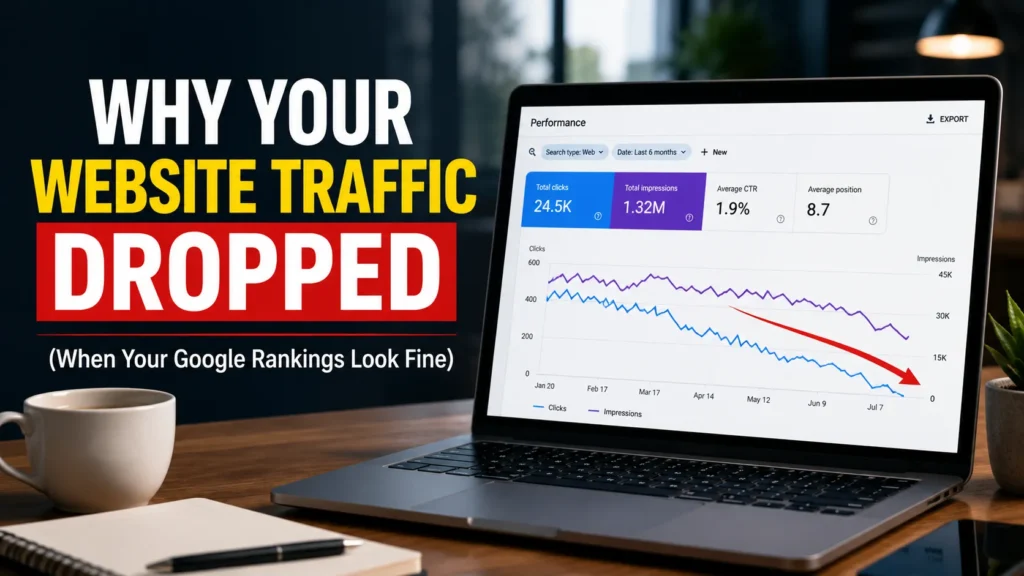
This helps explain a frustrating pattern: your SEO agency shows you a report that says your rankings are stable, but your website analytics show fewer visitors. Both things are true at the same time. Your ranking hasn’t changed, but the number of clicks that ranking generates has dropped because Google is answering more queries directly on the search page.
SEO professionals call this “CTR compression.” It means the value of each ranking position is gradually declining because more Google features compete for the same screen space.
The Good News: Google Search Isn’t Dying
Before you reconsider your entire online strategy, here’s important context. Total Google search volume recently hit an all-time high. More people are searching than ever before. And organic search still delivers the highest return on investment of any marketing channel for most businesses.
What’s happening is not that search is becoming irrelevant. It’s that the rules for capturing search traffic are changing. The businesses that adapt will continue to benefit. The ones that keep doing what worked in 2022 will see continued decline.
What You Should Ask Your SEO Team Right Now
If your traffic has dropped and your rankings look fine, your SEO team or agency should be able to answer these questions. If they can’t, it’s a sign their reporting needs to evolve — or it may be time to look at technical SEO agencies that include this kind of analysis as standard.
“For our top keywords, what does the actual Google results page look like?” Your team should be able to show you screenshots of the search results and point out every feature that appears above your listing. If all they’re showing you is a position number, they’re giving you incomplete information.
“Are AI Overviews appearing for our keywords? Are we being cited in them?” Being cited inside an AI Overview is the new competitive advantage. Businesses that get cited there see significantly more clicks than those that don’t. Your team should know whether your content is being pulled into these summaries.
“What’s happening to our click-through rate over time?” In Google Search Console, your team can compare impressions (how many times your site appeared) against clicks (how many times people actually clicked). If impressions are stable but clicks are declining, that confirms the CTR compression pattern. This is the most important metric most SEO reports don’t include.
“Which of our keywords still have strong click opportunity?” Not all keywords are equally affected. Some searches still show a clean list of websites with minimal AI features. Others are dominated by AI summaries, shopping results, and videos. Your team should be able to tell you which of your keywords still drive meaningful click traffic and which ones have been structurally reduced.
“Are we competing in the right content formats?” If Google is showing video results for a search term and your business only has written content, you’re not competing for the full results page. The same applies to local map listings, product carousels, and forum discussions. A good SEO strategy in 2026 goes beyond ranking a webpage — it means being present in the formats Google is actually displaying.
What You Can Actually Do About This
Understanding the problem is the first step. Here’s what practical action looks like.
Stop measuring success by rankings alone. Ask your team to track click-through rate by keyword alongside position. A keyword where you rank third with no AI features above you may be more valuable than a keyword where you rank first behind a full page of AI content and Shopping results.
Get your business into AI Overview citations. Content that gets cited inside Google’s AI summaries receives more visibility than content that only appears in organic listings. This typically requires content that answers specific questions directly, with clear expertise and supporting data. Your SEO team should have a strategy for this.
Diversify your content formats. If Google is showing videos for searches related to your business, producing video content gives you a second opportunity to appear on the results page. The same logic applies to local business optimization (Google Maps and Local Pack), product feeds (Shopping results), and genuine participation in relevant online communities (Discussion features).
Focus your investment on keywords that still convert. Not all traffic loss is equally damaging. Informational blog posts are the most affected by AI Overviews. Pages with clear buying intent — product pages, service pages, pricing pages — are much less affected. Make sure your most important commercial pages are fully optimized with solid on-page SEO.
Track the right metrics. Beyond rankings and traffic, start paying attention to branded search volume (are more people searching for your business by name?), conversion rate from organic traffic (fewer visitors but higher quality?), and whether your content is being cited in AI responses.
The Bottom Line
If your website traffic dropped and your rankings didn’t change, you’re not dealing with a penalty, a technical problem, or bad SEO work. You’re dealing with a structural change in how Google displays search results.
Google is no longer just listing websites. It’s assembling answers, products, maps, videos, discussions, and AI summaries on every search results page. Your website is competing for attention against all of those elements, not just against other websites.
The businesses that recognize this shift and adjust their strategy accordingly will capture the traffic that’s still available. The ones that keep checking their ranking position and wondering why the numbers don’t match anymore will keep falling behind.
Open Google. Search for what your customers search for. Look at the actual results page. The gap between your ranking and what your customers actually see — that’s where both the problem and the opportunity are.
If you want a professional diagnosis, a technical SEO audit can separate CTR compression from actual site problems — so you know exactly what’s structural and what’s fixable.