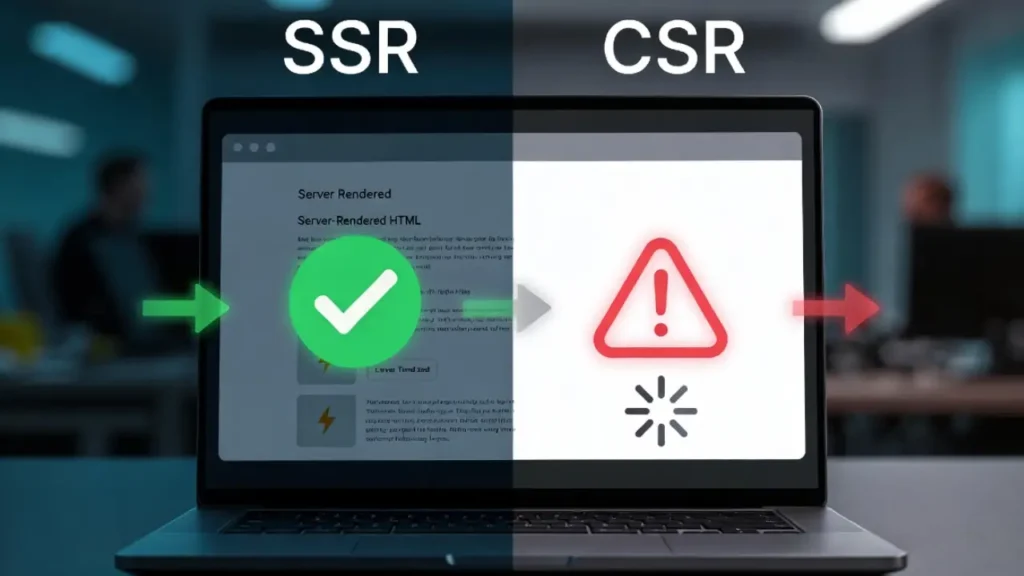
In the world of modern web development, SSR vs CSR has become one of the most critical technical decisions for any JavaScript-heavy website. The choice between Server-Side Rendering (SSR vs CSR) and Client-Side Rendering (SSR vs CSR) directly impacts your SEO performance, Core Web Vitals scores, crawl efficiency, and even how AI search engines discover your content. This complete guide breaks down everything you need to know about SSR vs CSR so you can make the right decision for your site.
By the end of this article, you will understand the real differences in SSR vs CSR, their SEO implications, implementation steps, and which strategy wins for different types of websites. Whether you run a React SPA, a Next.js application, or a Vue/Nuxt project, mastering SSR vs CSR is now essential for technical SEO success.
What Is Server-Side Rendering (SSR) and How Does It Work?
Server-Side Rendering (SSR vs CSR) means the server generates the full HTML for each page request before sending it to the browser. In SSR vs CSR discussions, SSR delivers complete, ready-to-render content immediately.
When a user (or search engine crawler) requests a page using SSR, the server fetches data, renders the HTML, and sends a fully formed page. The browser then hydrates the JavaScript for interactivity. This approach is the foundation of frameworks like Next.js, Nuxt, and traditional server-rendered apps.
In SSR vs CSR, SSR shines for content-heavy sites because search engines receive meaningful HTML right away. No waiting for JavaScript execution.
What Is Client-Side Rendering (CSR) and How Does It Work?
Client-Side Rendering (SSR vs CSR) is the default for most single-page applications (SPAs) built with React, Vue, or Angular. In SSR vs CSR, the server sends a minimal HTML shell with JavaScript bundles. The browser then downloads and executes that JavaScript to render the full content.
In SSR vs CSR comparisons, CSR creates highly interactive experiences but delays content visibility. Search engines must run JavaScript to see the page, which consumes extra crawl budget and can lead to indexing delays or incomplete rendering.
SSR vs CSR: Detailed Side-by-Side Comparison
When evaluating SSR vs CSR, the differences become clear across key metrics:
- Initial Load Speed: SSR wins in SSR vs CSR because content appears instantly. CSR often shows a blank screen until JavaScript loads.
- Core Web Vitals: SSR generally delivers better LCP and INP in SSR vs CSR tests. CSR struggles with Largest Contentful Paint.
- SEO Crawlability: In SSR vs CSR, SSR provides full HTML to Googlebot immediately. CSR relies on Google’s JavaScript rendering, which can be delayed or limited.
- Server Load: CSR is lighter on the server in SSR vs CSR scenarios, while SSR requires more server resources per request.
- Interactivity: CSR excels in SSR vs CSR for complex dashboards and real-time apps after the initial load.
- Caching: SSR works beautifully with edge caching in SSR vs CSR setups; CSR is harder to cache effectively.
Many benchmarks show SSR outperforming CSR by 30–50% in organic traffic for content sites when comparing SSR vs CSR directly.
How SSR vs CSR Affects Technical SEO
The impact of SSR vs CSR on SEO cannot be overstated. Google and other search engines have improved JavaScript rendering, but SSR vs CSR still favors SSR for most public-facing pages.
In SSR vs CSR, SSR ensures meta tags, structured data, and content are available in the initial HTML response. This leads to faster indexing and better AI crawler visibility. CSR pages risk partial indexing or delayed ranking because crawlers must execute JavaScript.
SSR vs CSR also influences crawl budget. SSR pages use less of Google’s rendering resources, allowing more pages to be crawled and indexed. For large JavaScript sites, choosing the wrong side in SSR vs CSR can waste crawl budget and hurt rankings.
Core Web Vitals scores are consistently higher with SSR in SSR vs CSR tests, especially LCP and Cumulative Layout Shift. Better vitals mean better rankings.
Social sharing and preview cards also work more reliably with SSR in SSR vs CSR because the HTML contains the actual content.
When to Choose SSR in the SSR vs CSR Debate
Use SSR when evaluating SSR vs CSR if your site falls into these categories:
- Content-heavy websites (blogs, news, marketing sites)
- Ecommerce product pages where SEO drives traffic
- Landing pages and lead-generation funnels
- Sites targeting AI search visibility
- Any public page where first-load speed and crawlability matter
In SSR vs CSR, SSR is the clear winner for any page you want Google to rank quickly.
When to Choose CSR in the SSR vs CSR Debate
CSR still has strong use cases in SSR vs CSR decisions:
- Internal dashboards and authenticated user areas
- Highly interactive web applications (SaaS tools, editors)
- Pages behind login where SEO is irrelevant
- Real-time data apps (live charts, collaborative tools)
In SSR vs CSR, CSR reduces server load and provides buttery-smooth navigation once loaded.
Hybrid Rendering: The Best of Both Worlds in SSR vs CSR
Most experts recommend hybrid approaches when weighing SSR vs CSR. Modern frameworks like Next.js App Router and Nuxt 3 make it easy to mix strategies:
- Use SSR or SSG for public SEO-critical pages
- Use CSR for interactive components inside those pages
- Leverage React Server Components for selective server rendering
This balanced SSR vs CSR strategy delivers excellent SEO while maintaining high interactivity. Many sites report 40%+ traffic gains after moving from pure CSR to hybrid SSR vs CSR setups.
Implementing SSR vs CSR: Practical Code Examples
Next.js (App Router) – SSR Example
export default async function Page() {
  const data = await fetchData(); // Runs on server
  return <div>{data.title}</div>;
}
React CSR Example
'use client';
export default function Page() {
  const [data, setData] = useState(null);
  useEffect(() => { fetchData().then(setData); }, []);
  // ...
}
For WordPress + headless setups, combine with our Reduce TTFB in WordPress guide to optimize server response times in SSR vs CSR implementations.
Testing SSR vs CSR Performance and SEO Impact
Use these tools to measure your SSR vs CSR choice:
- Google PageSpeed Insights and Lighthouse
- WebPageTest.org (compare First Contentful Paint)
- Google Search Console (Coverage and Indexing reports)
- Screaming Frog or Sitebulb with JavaScript rendering enabled
Monitor how your SSR vs CSR setup affects indexing speed and organic impressions.
Common Mistakes in SSR vs CSR Implementation
Many teams make costly errors when choosing SSR vs CSR:
- Using pure CSR for public content pages
- Overusing SSR on pages that don’t need it (increasing server costs)
- Forgetting proper hydration in hybrid SSR vs CSR setups
- Ignoring mobile performance differences in SSR vs CSR
- Not updating meta tags dynamically in SSR
Avoid these pitfalls by auditing your current rendering strategy against our technical SEO checklist.
Real-World Results from SSR vs CSR Migrations
Clients who switched from CSR to SSR or hybrid SSR vs CSR through our technical SEO services saw:
- 25–45% faster indexing of new pages
- 15–30% improvement in organic traffic within 90 days
- Significantly better LCP and INP scores
- Higher citation rates in AI search results
One ecommerce client increased product page rankings dramatically after adopting SSR in their SSR vs CSR strategy.
The Future of SSR vs CSR with AI Search and JavaScript SEO
SSR vs CSR decisions also affect AI crawlers. SSR provides cleaner, more structured content for llms.txt optimization and generative search. Pure CSR pages risk being underrepresented in AI answers.
Pair your SSR vs CSR choice with strong security headers, proper structured data, and robots.txt rules for complete technical SEO coverage.
Conclusion: Make the Right SSR vs CSR Decision Today
SSR vs CSR is no longer just a developer preference — it is a core technical SEO lever that affects rankings, user experience, and future-proofing. For most public websites, leaning toward SSR or hybrid rendering in the SSR vs CSR debate delivers the best results.
Ready to optimize your JavaScript site with the right SSR vs CSR strategy? Our team at Cope Business specializes in advanced technical SEO implementations, including full rendering audits and migrations.
→ Get your free technical SEO audit
→ Contact us today to discuss your SSR vs CSR project
→ Explore our complete technical SEO services
Don’t let the wrong choice in SSR vs CSR hold your rankings back. Audit your rendering strategy now and start seeing better SEO performance.
Frequently Asked Questions
SSR vs CSR refers to Server-Side Rendering versus Client-Side Rendering. In SSR vs CSR, the server generates full HTML before sending it to the browser, while in CSR the browser downloads JavaScript and renders the page on the client side. SSR vs CSR greatly affects SEO, speed, and user experience.
In most cases, SSR performs better for SEO than CSR. SSR vs CSR favors SSR because search engines receive complete HTML immediately, leading to faster indexing, better Core Web Vitals, and higher rankings. CSR can cause crawling and indexing issues in SSR vs CSR comparisons.
Google can crawl CSR websites, but it still requires extra resources to execute JavaScript. In SSR vs CSR, SSR pages are crawled and indexed more reliably and quickly. For important public pages, SSR vs CSR strongly recommends using SSR or hybrid rendering.
Choose SSR when evaluating SSR vs CSR for content-heavy sites, ecommerce product pages, blogs, landing pages, or any public page where SEO and fast first load matter. SSR vs CSR favors SSR for pages you want to rank well in Google and AI search.
CSR is better in SSR vs CSR for internal dashboards, admin panels, highly interactive SaaS tools, or pages behind login where SEO is not important. CSR provides smoother interactivity once loaded but performs weaker in SSR vs CSR for public SEO-focused pages.
Hybrid rendering combines SSR and CSR. In SSR vs CSR strategy, hybrid approaches (like Next.js App Router) use SSR or SSG for public pages and CSR for interactive parts. Most experts consider hybrid rendering the best balance in SSR vs CSR for both SEO and performance.
Yes. SSR vs CSR has a big impact on Core Web Vitals. SSR usually delivers better Largest Contentful Paint (LCP) and Interaction to Next Paint (INP) compared to pure CSR. Choosing the right side in SSR vs CSR helps improve your Page Experience signals.
In Next.js, use Server Components or getServerSideProps for SSR. In pure React, you need frameworks like Next.js for easy SSR. When deciding SSR vs CSR, Next.js makes it simple to choose rendering methods per page or component.
Yes, many websites successfully migrate from CSR to SSR or hybrid rendering. In SSR vs CSR migrations, teams often see significant improvements in organic traffic, indexing speed, and Core Web Vitals after switching. Proper planning is important during the transition.
For ecommerce websites, SSR vs CSR strongly recommends SSR or hybrid rendering for product pages, category pages, and landing pages. This improves SEO, loading speed, and conversion rates. Use CSR only for user account sections where SEO is less critical.
Still have questions about SSR vs CSR for your website? Contact our technical SEO team for a free audit and personalized rendering strategy recommendation.