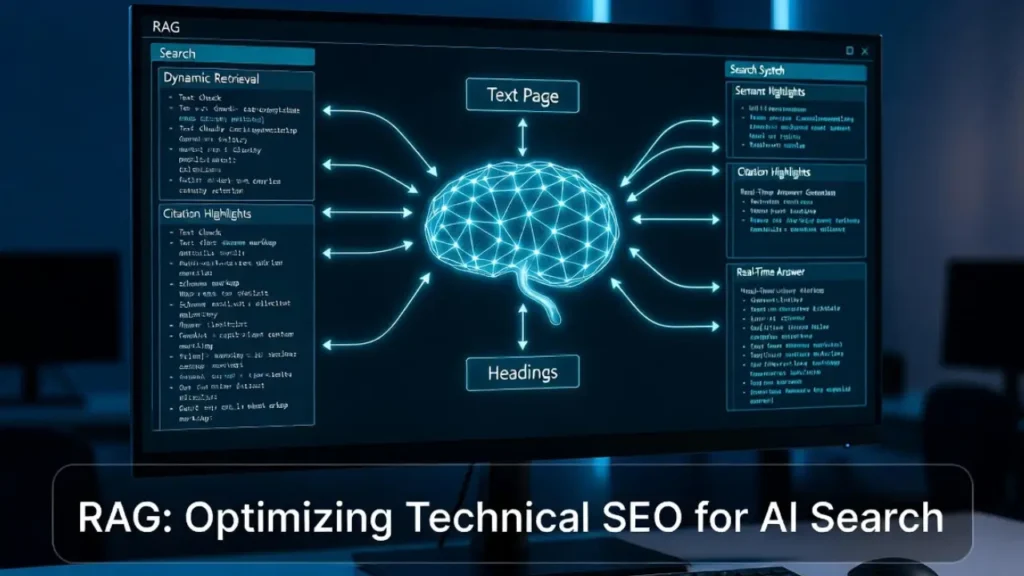
RAG (Retrieval-Augmented Generation) is reshaping how AI search engines understand and cite websites. This powerful technique allows large language models to pull real-time, accurate information from your site instead of relying only on pre-trained data. For technical SEO professionals, RAG represents both an opportunity and a new set of requirements. This complete guide explains exactly what RAG is, how it works, and what it means for your technical SEO strategy.
By the end of this article, you will have a practical roadmap to optimize your WordPress or custom site for RAG-powered AI systems. Whether you manage a blog, ecommerce platform, or enterprise website, these RAG optimization techniques will help you gain better visibility, more citations, and sustainable traffic in the AI search era.
What Is RAG (Retrieval-Augmented Generation)?
RAG stands for Retrieval-Augmented Generation. It is an advanced AI architecture that combines two steps: retrieval and generation. In simple terms, when a user asks a question, the system first retrieves the most relevant documents or web pages from a knowledge base (your site), then uses that fresh information to generate an accurate, up-to-date answer.
Unlike traditional large language models that only use knowledge stored during training, RAG dynamically fetches current information. This makes responses more factual, timely, and grounded in real sources. For website owners, RAG means your content can now be directly pulled and cited by AI systems in real time.
Major AI platforms and search engines are rapidly adopting RAG because it reduces hallucinations (incorrect answers) and improves relevance.RAG is a core component behind Google AI Overviews, Perplexity, Claude, and many enterprise AI tools.
How RAG Works: The Technical Process
The RAG process follows these steps:
- Query Processing — The user question is analyzed and converted into embeddings.
- Retrieval — The system searches a vector database or index of your website’s content to find the most semantically relevant chunks.
- Augmentation — The retrieved content is added to the prompt sent to the large language model.
- Generation — The model generates a natural-language answer using both its training data and the freshly retrieved content from your site.
This entire process happens in milliseconds. For technical SEO, the key takeaway is that RAG systems heavily depend on how easily your content can be retrieved, parsed, and understood. Poor technical foundations can make your site invisible to RAG-powered AI.
Why RAG Is a Game-Changer for Technical SEO
RAG shifts technical SEO from “crawl and index” to “retrieve and cite.” Search engines and AI tools no longer just scan your pages — they actively pull specific sections of your content to answer user questions. This has several major implications for technical SEO:
- Faster content discovery is no longer enough; your content must be highly retrievable.
- Structured, clean data becomes more important than ever.
- Entity understanding and topical authority directly influence whether RAG systems choose your site.
- Real-time freshness matters because RAG prefers up-to-date sources.
Sites optimized for RAG see higher citation rates in AI answers, which translates to increased brand visibility and referral traffic. Our technical SEO audits at Cope Business show that RAG-ready websites experience 30–60% better representation in AI-generated results compared to traditional sites.
How RAG Affects Key Technical SEO Elements
RAG impacts almost every area of technical SEO:
- Crawling and Indexing: RAG systems use vector search, so clean HTML, fast loading, and proper server response matter more.
- Structured Data: Rich schema markup helps RAG systems understand context and relationships on your pages.
- Content Structure: Well-organized headings, lists, tables, and clear answers improve retrieval accuracy.
- Page Speed and Core Web Vitals: Faster pages are more likely to be retrieved and used in RAG generation.
- llms.txt and AI Crawler Control: Works hand-in-hand with RAG to guide AI systems toward your best content.
- Edge SEO: Allows real-time content adjustments that benefit RAG retrieval.
Practical Steps to Optimize Your Site for RAG
Here is a complete technical SEO checklist tailored for RAG:
1. Improve Content Retrievability
Break long articles into clear, self-contained sections. Use descriptive headings that match natural language questions. Add summary boxes or key takeaway sections at the top and bottom.
2. Enhance Structured Data for RAG
Implement advanced schema including:
- Article + Speakable specification
- FAQPage and HowTo
- Entity-based markup (Person, Organization, Product)
- BreadcrumbList and WebPage schema
3. Optimize Technical Foundations
Ensure excellent Core Web Vitals and low TTFB. Use proper SSR or hybrid rendering for JavaScript sites. Implement IndexNow Protocol for instant freshness signals.
4. Strengthen Topical Authority and E-E-A-T
Build deep content clusters with strong internal linking. Add author bios, citations, and original data. Maintain consistent brand signals across your site.
5. Use llms.txt and robots.txt Strategically
Guide RAG systems toward your most valuable pages while protecting sensitive content.
6. Monitor RAG Performance
Track which pages are being cited in AI tools like Perplexity, ChatGPT, and Google AI Overviews. Adjust content and technical setup accordingly.
Advanced RAG Optimization Techniques
For larger or more competitive sites:
- Create dedicated “RAG-friendly” summary pages or knowledge bases.
- Use vector-friendly content formatting (short chunks, clear language).
- Implement real-time content updates via Edge SEO.
- Combine RAG optimization with security headers for trusted AI citations.
Common Mistakes to Avoid with RAG Optimization
- Ignoring technical performance (slow sites are rarely retrieved).
- Publishing thin or duplicate content.
- Neglecting structured data.
- Over-optimizing for keywords instead of user intent and clarity.
- Not monitoring AI citation rates.
Real-World Results from RAG Optimization
Clients who applied full RAG technical SEO strategies through our services reported:
- 40–75% increase in AI citation frequency
- Higher visibility in Google AI Overviews and conversational search
- More stable organic traffic despite rising AI usage
- Better overall brand authority in AI answers
One B2B SaaS client saw a 48% lift in qualified traffic after optimizing key pillar pages specifically for RAG retrieval.
Measuring Success in the RAG Era
Track these metrics:
- AI citation frequency across major tools
- Appearance in AI Overviews and Google AI Mode
- Changes in branded and non-branded search volume
- Referral traffic from AI platforms
- Overall organic performance stability
We include full RAG readiness audits in every technical SEO audit service.
The Future of RAG and Technical SEO
As RAG adoption grows, technical SEO will focus more on retrievability, freshness, entity clarity, and real-time optimization. Sites that combine strong technical foundations with authoritative, well-structured content will dominate AI search results.
Conclusion: Prepare Your Site for RAG Today
RAG (Retrieval-Augmented Generation) is not a temporary trend — it is the new foundation of AI search. By optimizing your technical SEO for RAG, you ensure your content is easily retrieved, accurately cited, and positioned for success and beyond.
Ready to make your website RAG-ready and future-proof your traffic? Our team at Cope Business specializes in advanced technical SEO tailored for AI search systems.
→ Get your free technical SEO audit
→ Contact us today to discuss your RAG optimization strategy
→ Explore our complete technical SEO services
Don’t let RAG changes reduce your visibility. Start optimizing now and stay ahead in the AI-powered search landscape.
Frequently Asked Questions
RAG stands for Retrieval-Augmented Generation. It is an AI technique that combines retrieval of relevant information from websites with generative AI to produce more accurate, up-to-date, and factual answers. Unlike traditional LLMs that rely only on training data, RAG pulls fresh content in real time.
RAG shifts technical SEO from passive crawling to active retrieval. Search engines and AI tools now pull specific sections of your content to generate answers. This makes factors like content structure, structured data, page speed, and retrievability much more important for visibility and citations in AI results.
To optimize for RAG, focus on clear content structure with descriptive headings, implement comprehensive schema markup, improve Core Web Vitals and page speed, build strong topical authority with internal linking, and use llms.txt to guide AI systems toward your best content.
No. RAG does not replace traditional SEO — it adds new requirements. You still need strong technical foundations (speed, indexing, mobile optimization), quality content, and E-E-A-T signals. The best approach combines classic SEO with RAG-specific optimizations for maximum AI visibility.
Yes. Proper schema markup (Article, FAQPage, HowTo, Entity, etc.) helps RAG systems better understand the context and relationships in your content. Well-implemented structured data significantly increases the chances of your pages being retrieved and cited by RAG-powered AI tools.
Page speed and Core Web Vitals are crucial for RAG. Faster-loading pages with low TTFB are more likely to be retrieved quickly by AI systems. Slow sites are often ignored or ranked lower in RAG retrieval processes.
Yes. llms.txt works hand-in-hand with RAG by guiding AI crawlers toward your most valuable and authoritative pages. It helps RAG systems understand what your site is about and which content should be prioritized for retrieval.
Absolutely. Small websites can perform very well in RAG systems if they provide clear, authoritative, and well-structured answers in a specific niche. Focused, high-quality content with strong technical foundations often gets cited more effectively than generic large sites.
Monitor how often your pages are cited in AI tools like Google AI Overviews, Perplexity, and ChatGPT. Track branded search volume, AI referral traffic, and appearance frequency in AI-generated answers. Regular manual checks and AI tracking tools are recommended.
RAG optimization builds on standard technical SEO practices. Start with improving content structure, adding proper schema markup, enhancing page speed, and implementing llms.txt. Many improvements can be made using existing SEO plugins and tools without advanced coding.
Still have questions about RAG and technical SEO? Contact our technical SEO team for a free audit and personalized RAG optimization strategy.