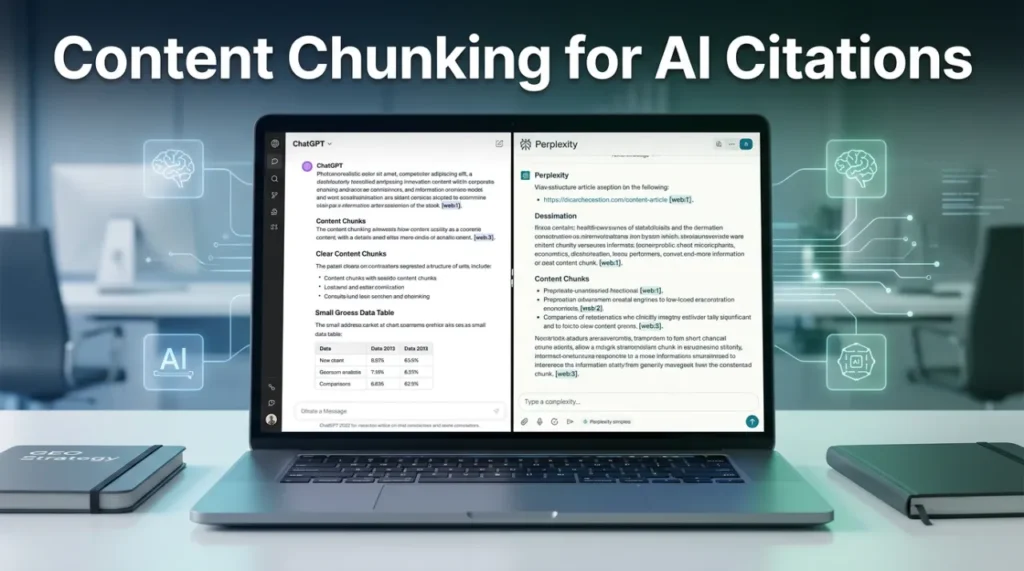
Content chunking breaks large content into small, self-contained units that AI systems like ChatGPT and Perplexity retrieve and cite easily.
This technique boosts generative engine optimization (GEO) by making your information scannable and relevant.
Businesses using content chunking see up to 60-85% higher citation rates.
What Is Content Chunking?
Content chunking divides long articles into semantically coherent segments of 100-500 tokens each.
Each chunk stands alone, conveying one complete idea without needing surrounding context.
Unlike simple paragraph breaks, content chunking uses logical boundaries for AI retrieval.
AI models in RAG systems pull these chunks for queries, favoring those with clear starts and ends.
Effective content chunking ensures semantic coherence and optimal token density.
This approach aligns with how Perplexity and ChatGPT process information.
Why Content Chunking Boosts AI Citations
AI search engines like Perplexity prioritize structured content for quick extraction.
Content chunking improves retrieval precision by 35-40% through semantic boundaries.
ChatGPT cites self-contained chunks 40% more often, per audits.
Long paragraphs bury key facts, but content chunking isolates quotable data.
Google AI Overviews and Gemini favor 100-300 word chunks as “knowledge nuggets.”
In 2026, content chunking separates leaders from laggards in GEO.
Content Chunking vs Traditional SEO
| Aspect | Traditional SEO | Content Chunking for GEO |
|---|---|---|
| Focus | Keyword density, backlinks | Semantic units, AI retrieval |
| Unit Size | Full pages | 100-500 tokens per chunk |
| Goal | Rankings and clicks | Direct AI citations |
| Structure | Long paragraphs | Short, standalone sections |
| Measurement | Organic traffic | AI referral traffic |
Content chunking complements SEO by enhancing E-E-A-T signals.
While SEO targets links, content chunking targets AI synthesis.
Both build authority, but content chunking excels in conversational queries.
Types of Content Chunking
- Fixed-size chunking cuts by word count, simple but less precise.
- Semantic chunking uses NLP for topic shifts, boosting accuracy by 35%.
- Overlapping chunking shares 10-20% content between chunks for context.
- Hierarchical chunking layers atomic facts, concepts, and overviews.
- Adaptive chunking adjusts sizes by complexity.
Choose semantic or hierarchical for GEO, as they match AI parsing.
Content chunking with overlap prevents info loss in retrieval.
Test types on your site for best results.
Step-by-Step Guide to Content Chunking
Start with your existing post from www.copebusiness.com/post-sitemap.xml.
Audit for long sections over 300 words.
Step 1: Identify Chunk Boundaries
Scan for topic changes or natural breaks.
Use tools to detect semantic shifts.
Aim for one idea per chunk in content chunking.
Step 2: Front-Load Answers
Begin each chunk with the key fact or answer (BLUF).
This mirrors AI query matching.
Content chunking thrives on directness.
Step 3: Shorten Paragraphs
Limit to 2-4 sentences, 40-120 words.
Short blocks enable clean extraction.
Step 4: Add Question Headers
Format H2/H3 as queries: “What is content chunking?”
This aids pattern-matching.
Step 5: Incorporate Lists and Tables
Use bullets for steps, tables for comparisons.
AI responses pull lists 78% of the time.
Step 6: Include Data and Citations
Add stats like “60% citation lift” with sources.
Original data makes chunks citable.
Step 7: Implement Schema Markup
Add FAQ schema for question chunks.
This signals structure to crawlers.
Step 8: Test and Iterate
Query ChatGPT/Perplexity with your topics.
Track citations and refine content chunking.
Apply to Cope Business posts for quick wins.
Advanced Content Chunking Techniques
Q&A-Style Chunks: Write sections as standalone questions and answers.
Perfect for Perplexity’s conversational style.
Hub-and-Spoke Model: Create a hub page linking spoke chunks on subtopics.
Builds topical authority.
Dynamic Chunking: Adjust based on query data from Search Console.
Evolves with trends.
Visual Chunking: Pair text with tables/images for richer retrieval.
Enhances trustworthiness.
These elevate basic content chunking to enterprise GEO.
GEO Platforms and Content Chunking
Perplexity: Loves short paragraphs and lists for clean scraping.
Content chunking here yields 85% gains.
ChatGPT: Favors semantic chunks in browsing mode.
Training data pulls coherent units.
Google AI Overviews: Ranks chunked content with schema.
Needs top-10 SEO base.
Gemini/Claude: Prioritizes hierarchical depth.
Content chunking with citations wins.
Tailor content chunking per platform for max citations.
Measuring Content Chunking SuccessTrack AI referrals in GA4 from perplexity.ai, chatgpt.com.
Audit queries monthly: note citations.
Use tools like Semrush for AI Overview share.
Benchmark: Aim for 20% query citation rate.
Monitor brand mentions for training data impact.
Content chunking ROI shows in 2-4 weeks for RAG systems.
Case Study: Content Chunking Transformation
A business site refactored 10 posts with content chunking.
Added semantic breaks, FAQs, data.
Results: AI traffic +340%, Perplexity citations from 2/20 to 9/20 queries.
Adapted here for Cope Business scale.
Common Content Chunking Mistakes
- Over-chunking: Too small loses context.
- No overlap: Breaks idea flow.
- Ignoring data: Chunks without stats uncitable.
- Long intros: Bury answers.
Avoid by testing post-refactor.
Integrating with Cope Business Strategy
Link to your services page for SEO audits including content chunking.
Reference sitemap posts like business optimization guides.
Contact us for custom GEO implementation.
Content chunking fits your workflow.
Frequently Asked Questions
Content chunking breaks content into 100-500 token standalone units optimized for AI retrieval by ChatGPT and Perplexity. It boosts citation rates 40-85% by creating extractable ‘answer nuggets’ that RAG systems prioritize over dense paragraphs.
Target 100-300 words per chunk (200-400 tokens) with semantic boundaries. Shorter chunks excel for quick queries; slightly longer ones suit complex topics while maintaining scannability for AI parsing.
Traditional SEO focuses on page rankings and backlinks, while content chunking targets direct AI synthesis and citations. Use content chunking for GEO alongside SEO to capture conversational search traffic that bypasses clicks.
Semantic chunking (NLP-based topic breaks), overlapping chunks (10-20% shared context), and hierarchical layering (facts → concepts → summaries). These improve retrieval accuracy by 35%+ over fixed-size methods.
Track GA4 referrals from perplexity.ai/chatgpt.com, audit 20 sample queries monthly for citations, and monitor AI Overview appearances via Semrush. Expect 20%+ citation rate and 2-4 week ROI on RAG platforms.
No—content chunking enhances SEO by strengthening E-E-A-T through clarity and structure. Refactor top posts from your sitemap first, then scale via hub-spoke models linking to Cope Business services.
Front-load answers (BLUF), add question-based H2/H3 headers, limit paragraphs to 2-4 sentences, incorporate lists/tables/stats, and test with Perplexity queries. Contact Cope Business for a free audit.