In the fast-evolving world of search engine optimization, interna linking has always been a foundational element of technical SEO. It’s no longer just about manually adding a few relevant links here and there. Artificial intelligence has revolutionized how we approach internal linking—turning it into a data-driven, automated, and hyper-intelligent process that dramatically improves crawlability, topical authority, user experience, and ultimately, organic rankings.
At Cope Business, as a leading technical SEO agency with 15+ years of experience fixing complex site issues for clients worldwide, we’ve seen firsthand how AI-powered internal linking can recover lost traffic, eliminate orphan pages, and optimize crawl budgets on even the largest websites. This comprehensive guide goes beyond basic internal linking strategies (like our foundational internal linking strategy ) to deliver actionable, cutting-edge tactics tailored AI-first search landscape.
Whether you’re running a Shopify store, WordPress blog, or enterprise-level site, these strategies will help you build a flatter, smarter site architecture that search engines—and AI crawlers—love. Let’s dive in.
Why Internal Linking Remains Critical in Technical SEO
Internal linking refers to hyperlinks that connect one page on your website to another. Unlike external backlinks, these are fully under your control. They serve three primary purposes in technical SEO:
- Distributing Link Equity (PageRank Flow):High-authority pages pass “authority” to deeper or newer content.
- Guiding Crawlers and Improving Indexation: They reduce crawl depth and ensure search engines discover all your valuable pages efficiently.
- Enhancing User Experience and Dwell Time: Contextual links keep visitors engaged longer, signaling quality to algorithms.
Google’s entity-based understanding and AI-driven crawling prioritization have made internal linking even more powerful. Pages buried deeper than three clicks from the homepage often receive 70% less crawl frequency. Orphan pages (those with zero internal links) are frequently ignored entirely, leading to indexing issues and lost rankings.
Recent core updates have punished poor site architecture, with sites seeing 30-60% traffic drops from unoptimized linking alone. Conversely, well-executed internal linking strategies have delivered 200%+ traffic growth in case studies by strengthening topical clusters and semantic relationships.
This is where AI changes everything. Traditional manual linking is slow and subjective. AI tools analyze your entire content ecosystem using natural language processing (NLP), entity recognition, and competitor data to suggest—and even automate—perfectly contextual links at scale.
If your site struggles with crawl budget issues or low-indexed pages, start with our crawl budget optimization guide before implementing these AI strategies.
How AI Transforms Internal Linking: From Manual to Intelligent
AI doesn’t just speed up internal linking—it makes it smarter. Here’s< how:
- Semantic Analysis: AI understands context, entities, and user intent far beyond simple keyword matching.
- Predictive Recommendations: Tools scan your site (and competitors) to forecast which links will drive the most value.
- Automation at Scale: For sites with thousands of pages, AI handles bulk insertions while maintaining relevance.
- Orphan Page Detection & Recovery: Instant identification of isolated content.
- Anchor Text Optimization: AI suggests varied, natural-sounding anchors that build entity signals without over-optimization risks.
This aligns perfectly with preparing your site for AI-first search, as detailed in our post on preparing your website for AI-first search . Combined with semantic SEO importance
7 AI-Powered Internal Linking Strategies for Success
1. Build Bidirectional Topical Authority Clusters
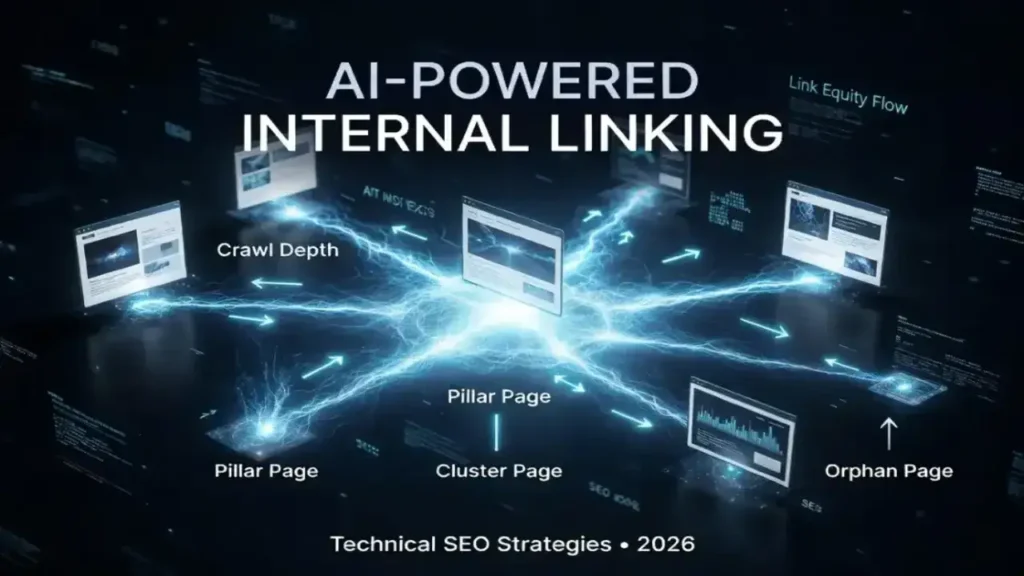
The hub-and-spoke model is now standard. Create comprehensive pillar pages that link out to 8-15 cluster pages. Every cluster page should link back to the pillar plus 2-3 related clusters.
AI Enhancement: Use tools to map content automatically into clusters based on entity similarity. Bidirectional linking signals deep topical expertise to both Google and LLM-based search engines.
Implementation Tip: Audit your site with AI tools (more on this below) and group content around core services or topics. Example: A dental clinic pillar on “Orthodontic Treatments” linking to clusters on braces types, Invisalign, and aftercare.
Expected Impact: 150-250% traffic uplift in competitive niches within 3-6 months.
2. Automated Internal Link Suggestions & Insertion
Manually reviewing thousands of pages is impossible. AI-powered tools scan existing content in real-time and recommend inline links with high contextual relevance.
Pro Strategy: Set rules for minimum relevance scores (e.g., 85%+) and limit 3-5 new links per page to avoid dilution.
This scales beautifully for large sites and integrates with automated technical SEO audits.
3. Orphan Page Recovery Protocol with AI
Orphan pages kill SEO potential. AI crawlers instantly flag them and suggest the most relevant linking opportunities from high-authority pages.
Step-by-Step:
- Run a full site crawl.
- Prioritize orphans by traffic potential or keyword volume.
- Add 2-3 contextual links from pillar/cluster pages.
- Schedule quarterly checks.
One client recovered 34 orphans and saw 23 pages rank in the top 10 within 45 days.
4. Smart Anchor Text Optimization Using Entity SEO
Gone are the days of repetitive exact-match anchors. AI recommends a natural mix:
- 10-20% exact-match
- 30-40% partial-match
- 30-40% LSI/entity-based (e.g., “crawl depth reduction techniques” instead of just “internal linking”)
This builds stronger entity graphs and avoids penalties.
5. Crawl Depth Flattening & Site Architecture Optimization
Ensure every important page is reachable within 3 clicks. AI helps visualize and restructure navigation, category pages, and breadcrumbs.
Cross-reference with our website architecture SEO guide for full technical implementation.
6. Predictive User Journey Linking
AI analyzes user behavior data (from Google Search Console or analytics) to suggest “next-step” links that match search intent progression—boosting dwell time and conversion rates.
7. JSON-LD & Schema-Enhanced Internal Linking
Combine internal links with structured data for richer signals. Our JSON-LD SEO automation post shows how to automate this layer.
Top AI-Powered Internal Linking Tools in
Here are the most effective tools based on real-world performance:
- LinkWhisper (Best for WordPress) – $77/year. Real-time AI suggestions, orphan finder, bulk insertion. Perfect for bloggers and small-to-medium sites.
- Surfer SEO – From $89/month. Competitor-informed linking + content grading.
- MarketMuse (Enterprise) – Custom pricing. Advanced topic cluster mapping and gap analysis.
- NeuronWriter – From $23/month. AI writing + linking briefs.
- Page Optimizer Pro – From $97/month. Deep LSI-based semantic linking.
- Alli AI – From $299/month. Rule-based automation for massive sites (Shopify/WordPress/custom).
- Frase.io & Clearscope – Affordable semantic-focused options.
- Outranking.io & SE Ranking – Excellent for clusters and technical audits.
Start with one tool matching your CMS and scale up. Many integrate directly with Google Search Console for prioritized recommendations.
Step-by-Step Implementation Guide
- Full Site Audit – Use Screaming Frog + AI tools to map current linking, orphans, and depth.
- Content Inventory & Clustering – Group pages semantically.
- Create/Update Pillar Pages – Ensure comprehensive coverage.
- Deploy AI Tool – Generate and review suggestions (always manual approval for quality).
- Bulk Implementation – Insert links with varied anchors.
- Monitor & Iterate – Track crawl stats, indexing, and traffic in Google Search Console.
- Ongoing Maintenance – Set automated alerts for new content.
Our technical SEO audit service includes this exact process with expert oversight.
Measuring Success: Key Metrics to Track
- Crawl depth reduction (target: <3 clicks for priority pages)
- Orphan pages eliminated (aim for zero)
- Indexed pages increase
- Organic traffic & impressions growth
- Average time on page and bounce rate improvements
- Keyword ranking lifts in cluster topics
Use Google Search Console, Ahrefs, or SE Ranking for dashboards.
Common Pitfalls to Avoid
- Over-linking (dilutes equity)
- Irrelevant or forced links (harms UX)
- Exact-match anchor spam
- Ignoring mobile navigation
- Set-and-forget mentality
Always prioritize user value over SEO manipulation.
Future Trends: AI & Internal Linking in 2027+
Expect deeper integration with LLM visibility, real-time dynamic linking based on user sessions, and automated entity graph building. Sites that treat internal linking as an AI-orchestrated system will dominate AI search results (e.g., ChatGPT, Perplexity, and Google’s AI Overviews).
Conclusion: Turn Internal Linking into Your Competitive Advantage
AI-powered internal linking isn’t a “nice-to-have”—it’s essential technical SEO in . By implementing these strategies, you’ll create a self-reinforcing site architecture that search engines reward with better indexing, higher rankings, and sustained organic growth.
Ready to audit and optimize your internal linking at scale? Our team at Cope Business specializes in fixing technical SEO issues that others miss.
Book a Free Technical SEO Audit Today
Explore our full range of Technical SEO services.
Have questions about implementing these strategies on your specific platform? Drop a comment below or reach out via our Contact page. Let’s build a future-proof site together.
Published by the Cope Business Technical SEO Team – Experts in AI-Driven SEO Solutions.
Frequently Asked Questions
It dramatically improves crawlability, reduces crawl depth, eliminates orphan pages, and strengthens topical authority signals.Google’s AI-first crawlers reward sites with intelligent internal linking by increasing indexing rates and passing more link equity. Real-world results show 150–250% traffic growth in competitive niches within 3–6 months when implemented correctly.
The top tools right now are LinkWhisper (best for WordPress), Alli AI (enterprise automation), MarketMuse (advanced topic clustering), Surfer SEO, NeuronWriter, and Page Optimizer Pro. They offer real-time suggestions, bulk insertion, orphan detection, and competitor-based recommendations. Choose based on your CMS and site size.
Orphan pages are website pages with zero internal links, making them invisible to Google crawlers. AI tools instantly scan your entire site, flag every orphan, and recommend the most relevant high-authority pages to link from. One of our clients recovered 34 orphan pages and ranked 23 of them in the top 10 within 45 days using this method.
A topical cluster consists of one comprehensive pillar page linking to 8–15 related cluster pages, with every cluster page linking back to the pillar and to other relevant clusters. AI makes building these clusters automatic by analyzing entity similarity. Bidirectional linking creates strong topical authority signals that both Google and LLM-based search engines reward heavily.
The golden rule is quality over quantity. Aim for 3–8 contextual internal links per page (maximum 10 on very long articles). AI tools automatically enforce relevance scores above 85% and natural anchor text distribution, preventing any dilution of link equity or Google penalties.
Yes — it is one of the fastest and most effective ways to fix crawl budget issues. By flattening site architecture and creating smart internal pathways, AI ensures important pages are crawled more frequently. Combine it with our crawl budget optimization guide for maximum results.
Most sites see initial improvements in crawl rate and indexing within 2–4 weeks. Significant ranking and traffic gains usually appear between 6–12 weeks, with full benefits visible in 3–6 months. Continuous AI monitoring and quarterly updates keep the momentum going.
Absolutely safe when done correctly. The key is relevance and user value — exactly what modern AI tools are designed to ensure. Avoid automated spam or irrelevant links. The strategies in this guide follow Google’s E-E-A-T and helpful content guidelines, making them future-proof.
Our technical SEO team offers complete end-to-end implementation — from full-site AI audit and cluster mapping to automated link deployment and ongoing monitoring. We’ve helped dozens of businesses recover lost traffic and achieve 200%+ growth. Book your free technical SEO audit today and let us build a powerful, AI-optimized internal linking system for your website.