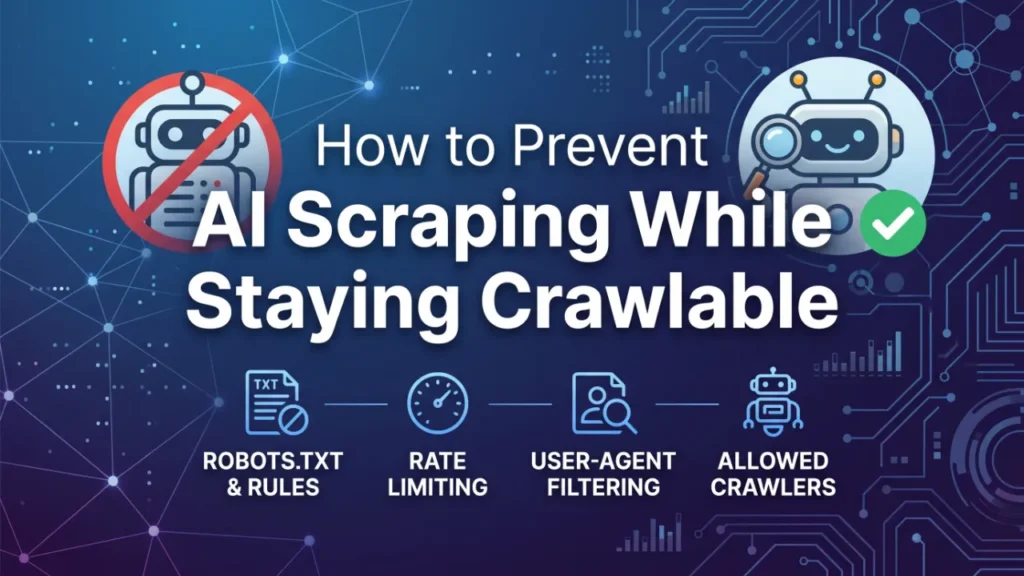
In the current digital landscape, website owners face a critical dilemma: how toblock AI scraping without losing search visibility. Every day, AI companies deploy bots like GPTBot, ClaudeBot, and Google-Extended to harvest your content for training large language models—often without attribution or compensation. Meanwhile, Googlebot and Bingbot remain essential for traditional SEO and AI-powered search features.
The challenge isn’t just technical; it’s strategic. You must block AI scraping efforts that target training crawlers, but allow search crawlers that drive traffic and citations. This guide provides a comprehensive, actionable framework to protect your content while maintaining full crawlability for search engines.
When youblock AI scraping correctly, you preserve your intellectual property while maintaining the search presence that brings customers to your door. The key is understanding which bots to block and which to welcome.
Why AI Scraping Is a Bigger Threat Now
The AI crawler landscape exploded recently. New bots appear monthly, and over 13% of AI bots now ignore robots.txt entirely—a staggering increase from previous years. This means polite requests alone are insufficient; you need multi-layered defenses to effectively block AI scraping.
Website owners who fail toblock AI scraping risk seeing their proprietary content, research, and creative work absorbed into training datasets without consent. This is particularly dangerous for publishers, e-commerce sites, and businesses that invest heavily in original content creation.
The urgency toblock AI scraping has never been higher. As AI models become more sophisticated, the quality of training data becomes more valuable—making your content a prime target for unauthorized harvesting.
The Three Types of AI Bots You Must Understand
Not all AI bots behave the same way. Misidentifying them leads to either ineffective protection or accidental SEO damage. Before you block AI scraping, understand these three categories:
1. AI Training Crawlers (Block These)
These bots scrape content to train foundation models. They provide zero attribution, zero traffic, and zero compensation. Examples include GPTBot (OpenAI), Google-Extended (Google), ClaudeBot (Anthropic), and CCBot (Common Crawl). These are the primary targets when you block AI scraping.
2. AI Search/Retrieval Crawlers (Consider Allowing)
User-driven bots like ChatGPT-User and PerplexityBot fetch content in real-time to answer queries. When allowed, they cite your site as a source, potentially driving engaged visitors. You don’t need to block AI scraping from these—they’re actually beneficial.
3. Search Engine Crawlers (Always Allow)
Googlebot and Bingbot power both traditional search and AI Overviews. Blocking them removes your site from discovery entirely. Never block AI scraping tools that are actually search crawlers.
Understanding this distinction is the foundation of any effective strategy toblock AI scraping while staying crawlable. Many website owners make the mistake of blocking everything, which destroys their SEO.
The Core Strategy: Selective Bot Governance
The winning approach now isn’t “block everything” or “allow everything.” It’s strategic filtering based on bot purpose and your business goals. When youblock AI scraping, precision matters more than aggression.
Businesses that successfullyblock AI scraping use a layered approach: robots.txt for polite bots, server rules for impolite ones, and monitoring to catch new threats. This multi-layered defense ensures comprehensive protection.
When to Block AI Scraping vs. When to Allow
| Bot Type | Action | Reason |
|---|---|---|
| Googlebot | Allow | Essential for indexing, rankings, and AI Overviews |
| Bingbot | Allow | Powers ChatGPT Search and Microsoft Copilot |
| GPTBot, ClaudeBot (training) | Block | No attribution; content used for model training |
| ChatGPT-User, PerplexityBot | Allow | User-driven searches that cite your content |
| Unknown/suspicious bots | Block | Likely malicious or resource-draining |
| Content scrapers | Block aggressively | No benefit, only bandwidth theft |
This selective approach ensures you block AI scraping from training bots while preserving visibility in both traditional and AI-powered search. The goal is surgical precision, not a sledgehammer.
Companies thatblock AI scraping indiscriminately often discover too late that they’ve also blocked their primary traffic sources. Always verify your rules before deploying them.
Layer 1: Robots.txt Configuration
Your robots.txt file is the first line of defense. While not all bots respect it, legitimate AI companies like OpenAI, Anthropic, and Google publish official user-agents that typically follow these rules. This is where you firstblock AI scraping attempts.
Many website owners ask: “Does robots.txt actually work to block AI scraping?” The answer is yes—for compliant bots. GPTBot, ClaudeBot, and Google-Extended generally honor robots.txt directives. However, you need additional layers for comprehensive protection.
Complete Robots.txt Template to Block AI Scraping
# Allow all search engine crawlers (CRITICAL - DO NOT BLOCK)
User-agent: Googlebot
Disallow:

User-agent: Bingbot
Disallow:

User-agent: DuckDuckBot
Disallow:

User-agent: YandexBot
Disallow:

# Block AI training crawlers
User-agent: GPTBot
Disallow: /

User-agent: Google-Extended
Disallow: /

User-agent: ClaudeBot
Disallow: /

User-agent: anthropic-ai
Disallow: /

User-agent: CCBot
Disallow: /

User-agent: Bytespider
Disallow: /

User-agent: cohere-ai
Disallow: /

# Allow AI search/retrieval crawlers (optional)
User-agent: ChatGPT-User
Allow: /

User-agent: PerplexityBot
Allow: /

# General rules for all other bots
User-agent: *
Disallow: /wp-admin/
Disallow: /wp-includes/
Disallow: /cart/
Disallow: /checkout/
Disallow: /*?filter=
Disallow: /*?sort=

# Sitemap declaration
Sitemap: https://www.copebusiness.com/post-sitemap.xml
This template is specifically designed to block AI scraping from training crawlers while maintaining full access for search engines. Copy it carefully and test before deploying.
Critical Robots.txt Best Practices
Never block CSS or JavaScript files. Googlebot needs these resources to render pages properly. Blocking them causes “indexed without content” issues and ranking drops. When you block AI scraping, always preserve access to these critical files.
Place the file at your root domain. It must be accessible at
https://www.copebusiness.com/robots.txt, not in subdirectories.
This is a common mistake that prevents the file from working.
Test before deploying. One incorrect rule can block your entire site from search engines. Use Google’s robots.txt Tester in Search Console to validate changes. Never block AI scraping without testing first.
Keep it under 512 KB. Search engines may truncate excessively large files. A concise, well-organized robots.txt file is more effective than a bloated one.
For more detailed guidance on configuring robots.txt properly, read our complete guide on how to optimize your WordPress robots.txt for SEO. This resource covers common pitfalls and advanced configurations.
If you’re specifically looking to block AI bots, our dedicated tutorial on blocking AI bots via robots.txt provides additional user-agent strings and implementation tips.
Layer 2: Meta Tags and HTTP Headers
For page-level control, implement meta tags that specifically target AI usage. While adoption varies, these tags provide granular protection beyond robots.txt. They help youblock AI scraping at the individual page level.
Meta tags are particularly useful when you want to block AI scraping on specific pages while allowing it on others. This granular control is impossible with robots.txt alone.
Meta Tags to Block AI Scraping
Add this to your HTML <head> section:
<meta name="robots" content="noai, noimageai">This signals that AI systems should not use this page’s content or images for training. Note that support is limited to specific crawlers like Microsoft’s Bingbot. While not universally enforced, it’s an important signal when youblock AI scraping.
HTTP Headers for Non-HTML Files
For PDFs, images, and other assets, use server-level headers:
X-Robots-Tag: noai, noimageaiThis is particularly important for downloadable resources, whitepapers, and proprietary research that you want to block AI scraping from accessing. Without these headers, your PDFs and images remain vulnerable even if your HTML is protected.
Understanding how to implement security headers properly is crucial. Our guide on security headers for SEO covers X-Robots-Tag and other protective headers in detail.
Layer 3: Server-Level Enforcement
Since over 13% of AI bots bypass robots.txt, you need technical enforcement at the server or CDN level. This is where you block AI scraping from non-compliant bots.
Server-level rules are your insurance policy. When polite requests fail toblock AI scraping, server enforcement catches the violators. This layer is essential for comprehensive protection.
Nginx Configuration
# Block known AI training crawlers by user-agent
if ($http_user_agent ~* (GPTBot|ClaudeBot|Google-Extended|CCBot|Bytespider|anthropic-ai|cohere-ai)) {
    return 403;
}

# Rate limiting for suspicious patterns
limit_req_zone $binary_remote_addr zone=ai_limit:10m rate=1r/s;

location / {
    limit_req zone=ai_limit burst=5 nodelay;
}
This Nginx configuration helps youblock AI scraping at the server level. The 403 Forbidden response tells non-compliant bots they’re not welcome.
Apache .htaccess Rules
RewriteEngine On
RewriteCond %{HTTP_USER_AGENT} (GPTBot|ClaudeBot|Google-Extended|CCBot|Bytespider|anthropic-ai|cohere-ai) [NC]
RewriteRule .* - [F,L]
Apache users canblock AI scraping using mod_rewrite rules in .htaccess. This approach is effective for shared hosting environments where server-level access is limited.
Cloudflare Bot Management
If you use Cloudflare (free tier available), enable Bot Fight Mode and create custom firewall rules:
- Navigate to Security > Bots
- Enable “Bot Fight Mode”
- Create custom rules targeting AI user-agents
- Set action to “Block” or “Challenge”
Cloudflare provides an accessible way to block AI scraping without modifying server configurations. It’s particularly useful for WordPress sites and small businesses.
Layer 4: Rate Limiting and Behavioral Analysis
Aggressive crawlers often reveal themselves through behavior patterns rather than user-agent strings alone. Smart rate limiting helps you block AI scraping without affecting legitimate users.
When youblock AI scraping based on behavior rather than identity, you catch bots that rotate user-agents or use residential proxies. This approach is more robust than simple user-agent blocking.
Identify Suspicious Crawl Patterns
Monitor your server logs for:
- High request frequency: More than 1 request per second from a single IP
- No referrer data: Legitimate crawlers typically include referrer information
- Sequential URL patterns: Bots often crawl in predictable sequences
- Missing JavaScript execution: Real browsers execute JS; simple scrapers don’t
These patterns help youblock AI scraping from sophisticated bots that disguise themselves as legitimate browsers. Behavioral analysis catches what user-agent filtering misses.
Implementation Tools
- Fail2Ban: Automatically ban IPs exhibiting scraper behavior
- Rate Limiting: Throttle requests without outright blocking (bots may not detect throttling)
- Honey Traps: Serve fake data to detected bots while protecting real content
Understanding crawler behavior is essential for effective protection. Our comprehensive guide on website crawlers explains how different bots behave and how to identify them in your logs.
For advanced monitoring, learn about log file analysis for SEO. This technique helps you spot scraping patterns before they cause significant damage.
Layer 5: Legal and Content Protection
Establish legal grounds for action while implementing technical measures. When youblock AI scraping, legal language strengthens your position.
Terms of Service Language
Add explicit language to your Terms of Service:
“Any automated crawling, scraping, or data extraction for AI training purposes without express written permission is prohibited. Violation constitutes acceptance of licensing terms at $X per page accessed.”
This language doesn’t physicallyblock AI scraping, but it creates legal standing if you need to take action against violators. It’s particularly important for high-value content.
Copyright Notice in Robots.txt
Following The New York Times’ approach, add legal language to your robots.txt:
# Legal Notice: Unauthorized AI training crawling prohibited
# Contact [email protected] for permissions
This notice reinforces your intent to block AI scraping and establishes that unauthorized access violates your terms.
Monitoring and Maintenance: The Critical Ongoing Step
Setting up blocks isn’t a one-time task. New AI crawlers launch monthly, and existing ones rebrand their user-agents. To effectively block AI scraping, you must stay vigilant.
The bots you block today may reappear tomorrow with new names. Continuous monitoring ensures your defenses remain effective as the threat landscape evolves.
Quarterly Maintenance Checklist
- Review server logs for new user-agent strings
- Check Dark Visitors directory for newly identified AI bots
- Verify Googlebot and Bingbot access using Search Console crawl stats
- Test robots.txt with Google’s testing tool
- Monitor bandwidth usage for unexplained spikes
- Update CDN rules if using Cloudflare or similar services
Regular maintenance is how you block AI scraping consistently over time. Without it, your defenses become outdated and ineffective.
Tools for Ongoing Monitoring
- Google Search Console: Monitor crawl stats and indexing status
- Cloudflare Analytics: Track bot traffic (free tier available)
- Server Log Analysis: Use tools like GoAccess or AWStats
- CrawlShield: Automated AI crawler detection and blocking
Monitoring your crawl budget is essential when managing bot traffic. AI scrapers can consume significant crawl budget that should be reserved for search engines.
If you notice indexing issues, check our guide on Google Search Console coverage errors to distinguish between AI scraper blocks and genuine crawl problems.
Common Mistakes That Destroy SEO
When youblock AI scraping, avoid these fatal errors that can devastate your search visibility:
Blocking Googlebot Accidentally
Googlebot powers both traditional search and AI Overviews. There is no separate “AI Overview bot”—blocking Googlebot removes you from both. Always double-check your user-agent rules before you block AI scraping.
This is the most common and most damaging mistake. One incorrect robots.txt line can erase years of SEO progress. Always verify before youblock AI scraping rules go live.
Using Disallow: / for All Bots
This blocks everything including search crawlers. Target specific user-agents only. Never use broad rules when you block AI scraping—precision is essential.
Blocking Resource Files
CSS and JavaScript files must remain accessible to Googlebot for proper rendering and indexing. When youblock AI scraping, never include these resources in your disallow rules.
Assuming Robots.txt Blocks Indexing
It only blocks crawling. Blocked URLs can still appear in search results without descriptions if linked elsewhere. Use meta robots tags for true indexing control. Toblock AI scraping from using your content, you need both crawling and indexing controls.
Ignoring Mobile Crawlers
Google primarily uses mobile-first indexing. Ensure your mobile site follows the same bot rules as desktop. When you block AI scraping, verify both mobile and desktop configurations.
The Future: Beyond Robots.txt
The robots.txt standard, created in 1994, struggles with today’s AI landscape. New standards are emerging to help you block AI scraping more effectively.
llms.txt: The Emerging Standard
The llms.txt file complements robots.txt by communicating usage preferences to AI systems. While not yet universally adopted, it provides a way to guide how AI systems consume your content and helps youblock AI scraping from specific sources.
Create a file at https://www.copebusiness.com/llms.txt:
# llms.txt for Cope Business
# Last updated: April 2025

# Allowed sections for AI retrieval
Allow: /blog/
Allow: /services/
Allow: /about/

# Disallowed sections
Disallow: /wp-admin/
Disallow: /private/

# Contact for licensing
Contact: https://www.copebusiness.com/contact/
This emerging standard gives you another tool to block AI scraping while maintaining transparency about your content usage policies.
Regulatory Developments
Recent regulatory proposals require major platforms to provide “meaningful and effective” control over AI content use. While regulations evolve, technical self-protection remains your best immediate defense. Don’t wait for laws to block AI scraping—act now.
Case Study: When Blocking Goes Wrong
A major publisher implemented aggressive AI blocking, adding
Disallow: / for all unknown user-agents. Within weeks, their
Google Search Console showed:
- 60% drop in crawl rate
- “Indexed without content” warnings
- Ranking drops for competitive keywords
The cause? An overly broad rule caught Googlebot’s mobile crawler (Googlebot Smartphone). After refining rules to target specific AI user-agents while explicitly allowing search crawlers, recovery took six weeks.
Lesson: Precision matters more than aggression when you block AI scraping. Always test your rules and verify search crawler access.
Action Plan: Implementing Your AI Scraping Defense
Follow this structured plan to block AI scraping effectively without harming your SEO:
Week 1: Audit Current Traffic
- Download server logs (or use hosting control panel)
- Identify current bot traffic by user-agent
- Benchmark server load and bandwidth usage
Week 2: Implement Robots.txt
- Deploy the template provided above
- Test with Google Search Console robots.txt tester
- Verify Googlebot and Bingbot can access key pages
Week 3: Add Meta Tags and Headers
- Implement noai, noimageai meta tags on content pages
- Configure X-Robots-Tag for PDFs and downloads
- Test header delivery using browser dev tools
Week 4: Server-Level Protection
- Implement Nginx/Apache rules or Cloudflare firewall rules
- Set up rate limiting
- Configure monitoring alerts
Ongoing: Quarterly Reviews
- Update blocked user-agent lists
- Monitor for new AI crawlers
- Adjust based on traffic and business goals
Following this plan ensures you block AI scraping systematically without missing critical steps. Rushing the implementation often leads to SEO disasters.
Conclusion
In the current era, the ability to block AI scraping while staying crawlable isn’t just a technical nicety—it’s essential content governance. The web is now majority bot traffic, with AI crawlers increasing dramatically year-over-year.
The strategy is clear:block AI scraping from training crawlers that provide no value, allow search crawlers that drive discovery, and consider allowing retrieval crawlers that cite your content. Implement layered defenses starting with robots.txt, adding meta tags, server rules, and ongoing monitoring.
Your content has value. Protect it strategically, not blindly. The goal isn’t to hide from the AI era—it’s to ensure your content serves your business goals, not someone else’s training dataset. When you block AI scraping correctly, you maintain control over your intellectual property while preserving the search visibility that drives your success.
Businesses that fail toblock AI scraping risk becoming free data sources for AI companies while losing the competitive advantage of their original content. Take action today to protect what you’ve built.
Need help implementing these protections? Contact our technical SEO team for a customized AI bot defense strategy, or explore our Technical SEO Services for comprehensive website protection.
For businesses looking to optimize their overall search strategy alongside bot protection, our AI SEO optimization services ensure you thrive in the AI-powered search landscape while keeping scrapers at bay.
Frequently Asked Questions
No. When youblock AI scraping from training bots like GPTBot, ClaudeBot, or Google-Extended, your Google rankings remain completely unaffected. These training crawlers do not influence search indexing or rankings in any way. Your search visibility depends entirely on Googlebot and Bingbot, which should always remain allowed. The key is toblock AI scraping selectively—target training crawlers while preserving full access for search engine crawlers that power traditional search and AI Overviews.
Googlebot crawls your site for search indexing and AI Overviews, while Google-Extended crawls specifically for AI model training. You shouldblock AI scraping from Google-Extended via robots.txt, but never block Googlebot. Blocking Googlebot removes your site from Google Search entirely—including AI Overviews—because there is no separate “AI Overview bot.” When youblock AI scraping, always verify that Googlebot and Bingbot remain whitelisted to maintain your search presence.
No, you cannotblock AI scraping entirely. Over 13% of AI bots ignore robots.txt directives, and user-initiated AI tools can still access your content when users manually paste your URLs. For the strongest protection, combine multiple layers: robots.txt for compliant bots, server-level rules (Nginx/Apache or Cloudflare) for non-compliant ones, meta tags for page-level control, and authentication for sensitive content. To effectivelyblock AI scraping, you need a multi-layered defense rather than relying on a single method.
Yes, in most cases you should allow them rather thanblock AI scraping from these sources. Unlike training crawlers, ChatGPT-User and PerplexityBot are user-driven retrieval bots that fetch content in real-time to answer queries—and they cite your website as a source. This can drive qualified, engaged traffic to your site. Onlyblock AI scraping from these bots if you want zero AI presence whatsoever. For businesses seeking visibility in AI-powered search, allowing these crawlers is a strategic advantage.
The most dangerous mistake is accidentally blocking Googlebot. Many site
owners use overly broad rules like User-agent: * combined
with Disallow: / toblock AI scraping, which catches
everything including search crawlers. Googlebot powers both traditional
search and AI Overviews—there is no separate crawler for AI features.
One incorrect robots.txt line can erase years of SEO progress. Always
test your rules with Google’s robots.txt Tester and verify that
Googlebot retains access before deploying any changes toblock AI
scraping.
Yes, absolutely. Robots.txt is only a polite request—over 13% of AI bots currently ignore it entirely. To reliablyblock AI scraping, you need server-level enforcement through Nginx configurations, Apache .htaccess rules, or Cloudflare firewall rules. These return 403 Forbidden responses that physically prevent non-compliant bots from accessing your content. Think of robots.txt as a “No Trespassing” sign and server rules as the actual fence. Both are necessary toblock AI scraping effectively.
You should review and update your rules quarterly at minimum. New AI crawlers launch monthly, and existing ones frequently rebrand their user-agent strings. A quarterly maintenance checklist should include: reviewing server logs for new user-agents, checking directories like Dark Visitors for newly identified AI bots, verifying Googlebot and Bingbot access in Search Console, testing robots.txt with Google’s testing tool, monitoring bandwidth for unexplained spikes, and updating CDN firewall rules. Consistent maintenance is how youblock AI scraping successfully over the long term.